News Flash: Claude's Text Output Now Carries & Top 3 Architect Dispatches?
1. Claude’s Text Output Now Carries an Invisible Watermark
The News Highlight:
Anthropic has integrated an invisible watermarking system into its latest Claude models, utilizing Google’s SynthID-Text technology to ensure compliance with the upcoming EU AI Act. This move addresses the growing regulatory demand for transparency in AI-generated content without compromising the user experience or the quality of the text. Unlike traditional watermarking methods that might insert hidden characters or metadata, this approach operates at the probabilistic level of token generation, making the origin of the text detectable by specialized tools while remaining completely imperceptible to human readers.
- SynthID-Text Integration: The system works by subtly "nudging" the probability distribution of word choices among near-equivalent options during the generation process.
- Zero Metadata Overhead: The watermark adds no hidden characters, extra tokens, or metadata, ensuring that the text remains clean for copy-pasting and standard processing.
- Privacy Preservation: Anthropic confirms that the watermark carries no information about the specific user or the prompt, focusing solely on identifying the content as AI-generated.
- Regulatory Alignment: The implementation is a proactive step to meet the transparency requirements of the EU AI Act, which mandates that AI systems label generated content.
DO-AI Analysis:
From an architectural standpoint, Anthropic is prioritizing "verifiable generation" as a core model feature rather than an afterthought. By embedding the watermark within the logits of the model itself, they avoid the brittleness of metadata-based tagging which is easily stripped. However, the trade-off is a theoretical reduction in the model's entropy; by "nudging" word choices, the model is technically restricted from its most "natural" probabilistic path. For enterprise teams, this means that while Claude remains a top-tier reasoning engine, we must monitor whether these invisible constraints impact highly creative or niche technical outputs where specific word choice is critical.
2. Perplexity JOLT: A Novel Self-Distillation Method
The News Highlight:
Perplexity has unveiled JOLT, a sophisticated self-distillation framework designed to bridge the gap between high-performing "teacher" models and efficient "student" models. Traditional distillation often involves a static teacher providing targets for a smaller model, but JOLT introduces a dynamic where the model is jointly trained to fulfill both roles. This allows the feedback loop to adapt specifically to the student's current capabilities, leading to significant performance gains in complex domains like mathematical reasoning, code generation, and autonomous agentic tasks.
- Joint Training Architecture: JOLT trains the model as both teacher and student simultaneously, creating a more fluid transfer of "reasoning logic" rather than just raw output.
- Adaptive Feedback: The method adjusts the complexity of the teacher's guidance based on the student's real-time performance, preventing the student from being overwhelmed by overly complex targets.
- Efficiency Benchmarks: Perplexity reports improved training efficiency and higher accuracy across benchmarks for reasoning-heavy tasks compared to standard distillation.
- Agentic Focus: The method is specifically optimized for "agentic" workflows, where the model must plan and execute multi-step sequences accurately.
DO-AI Analysis:
JOLT represents a shift toward "recursive optimization" in model training. The traditional bottleneck in distillation has always been the "capability gap"—if the teacher is too far ahead, the student learns the what but not the how. By making the teacher "meet the student where they are," Perplexity is solving a fundamental gradient mismatch problem. For engineering teams building specialized internal models, JOLT suggests that the future of fine-tuning isn't just about more data, but about building smarter, self-correcting feedback loops that allow smaller, cheaper models to punch significantly above their weight class in logic-heavy applications.
3. Deploying Trillion-Parameter Models on Cerebras WSE-3T
The News Highlight:
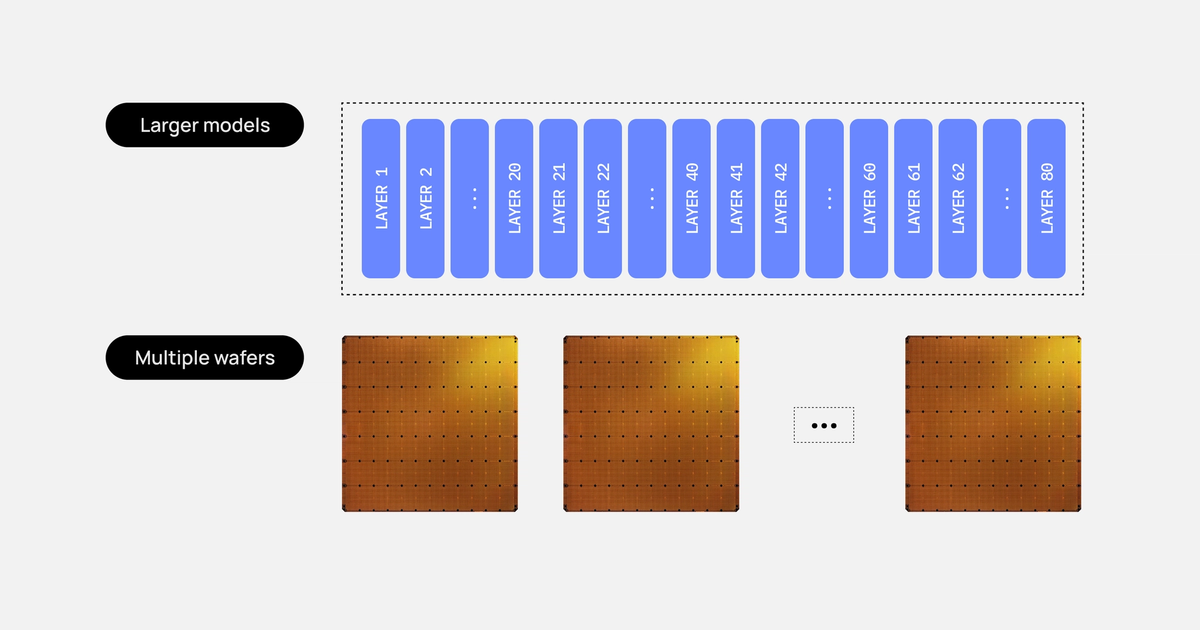
Cerebras has detailed its architectural strategy for deploying frontier models with over a trillion parameters, such as the 3-trillion parameter Kimi K3, on its Wafer-Scale Engine (WSE-3T). Despite the WSE-3T having 44 GB of ultra-fast on-chip SRAM—which is insufficient to hold a 3T model's weights—Cerebras utilizes a "weight-streaming" architecture to split models across multiple wafers. This approach allows them to run massive models at unprecedented speeds of 1000-2000+ tokens per second, effectively bypassing the memory bottlenecks that plague traditional GPU clusters.
- Wafer-Scale Splitting: Models like Kimi K3 (3T parameters) are mapped across multiple WSE-3T wafers, with specific layers assigned to individual chips to optimize memory and compute.
- Quantization Strategy: The deployment utilizes 4-bit weight quantization and 8-bit KV (Key-Value) cache to maximize the efficiency of the 44 GB on-chip SRAM.
- Layer-Specific Mapping: Dense layers, which require significant KV cache for concurrent requests, are typically placed one per wafer, while linear-attention layers (which have fixed-size states) can be packed more densely.
- High Throughput: The architecture is designed to handle high numbers of concurrent requests while maintaining millisecond-level latency, outperforming traditional H100/B200 clusters in raw inference speed.
DO-AI Analysis:
The Cerebras approach is a masterclass in hardware-software co-design, proving that the "memory wall" is the primary enemy of frontier AI. By moving away from the discrete GPU model and treating a cluster of wafers as a single continuous compute fabric, Cerebras eliminates the massive latency overhead of moving weights across PCIe or InfiniBand during inference. For architects, the takeaway is clear: as we move toward 3T+ parameter models, the "unit of compute" is shifting from the individual chip to the entire wafer. If your application requires real-time, high-throughput reasoning at the frontier level, the traditional "add more GPUs" strategy is reaching a point of diminishing returns compared to wafer-scale integration.
Morning Executive Comparison Matrix
| Dispatch |
Core Domain |
Production Maturity |
DO-AI Recommendation |
| Claude Watermarking |
AI Governance |
High (Production) |
Essential for EU-based deployments to ensure legal compliance. |
| Perplexity JOLT |
Model Training |
Emerging |
Evaluate for internal distillation pipelines to boost small-model logic. |
| Cerebras 3T Deploy |
Infrastructure |
Scaling |
Consider for ultra-low latency requirements in trillion-parameter agents. |