News Flash: Top Chinese Frontier AI Models & Top 3 Architect Dispatches?
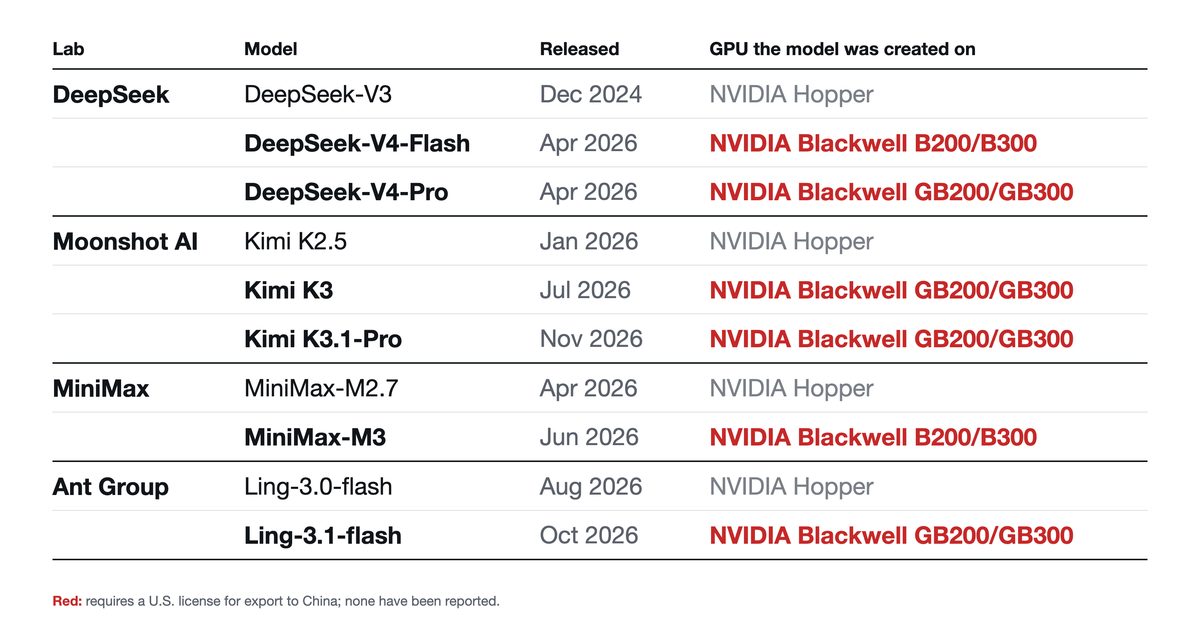
1. Top Chinese Frontier AI Models Carry the Fingerprint of Export-Controlled NVIDIA Blackwell GPUs
The News Highlight:
A forensic investigation by Unemployment Labs has uncovered technical evidence suggesting that several leading Chinese AI developers, including DeepSeek, Moonshot AI, MiniMax, and Ant Group, have gained access to NVIDIA’s restricted Blackwell GPUs. By analyzing the numerical patterns within the publicly released weights of six frontier models launched since April 2026, researchers identified "hardware fingerprints" that match the Blackwell architecture (B200/B300), contrasting with the Hopper-generation patterns found in earlier releases. While the report does not pinpoint the physical location of the chips or the specific method of acquisition, it provides the first concrete technical validation of claims that advanced, export-controlled compute is being utilized within the Chinese AI ecosystem.
- Numerical Fingerprinting: The analysis recovers traces of initial model values and matches them against specific hardware configurations; DeepSeek-V4-Flash and Kimi K3 were physically verified on Blackwell chips to confirm the match.
- Temporal Shift: Models released prior to early 2026 consistently showed patterns matching NVIDIA Hopper (H800), while subsequent flagship models shifted abruptly to Blackwell-specific signatures.
- Alternative Hardware Exclusion: Researchers evaluated specially configured AMD hardware as a potential source but excluded it for DeepSeek-V4-Flash and deemed it highly unlikely for the other five models.
- Scope of Access: The findings suggest that Blackwell is not just being used for small-scale testing but is actively performing the heavy lifting for training state-of-the-art frontier models.
DO-AI Analysis:
From an architectural standpoint, this discovery highlights the extreme difficulty of enforcing "hardware silos" in a globalized supply chain. The fact that hardware identity is encoded directly into the model weights—due to how different GPU architectures handle precision and rounding during initialization—creates a new form of "computational provenance." For engineering leads, the takeaway is that hardware-software co-design is now so tightly coupled that the underlying silicon leaves an indelible mark on the software artifact. This forensic capability will likely become a standard part of model auditing, moving beyond simple performance benchmarks to verifying the actual environmental and hardware conditions of a model's birth.
2. Eliminating Nondeterminism in LLM Inference with Integer-Only Arithmetic
The News Highlight:
The "DetLLM" project has introduced a method to achieve absolute determinism in Large Language Model (LLM) inference by replacing standard floating-point operations with integer-only arithmetic. Traditionally, LLM outputs can vary—even at "temperature 0"—because floating-point addition is non-associative; changing the batch size or the GPU type changes the order of operations, leading to different rounding errors and, eventually, different token selections. By utilizing exact integer addition for every component of the transformer architecture—including matrix multiplications, softmax, and rotary embeddings—DetLLM ensures bit-identical outputs across any hardware, whether it is an NVIDIA H100, an older A100, or a standard CPU.
- Floating-Point Non-Associativity: In standard FP16/BF16, $(a+b)+c$ does not always equal $a+(b+c)$, causing "drift" in long sequences when hardware kernels reorder operations for efficiency.
- Full-Stack Integer Implementation: DetLLM implements the entire inference pipeline (MatMul, Softmax, Normalization, RoPE) without a single floating-point operation.
- Cross-Platform Consistency: Testing across nine different configurations and three different machines resulted in identical hashes for integer runs, while floating-point runs diverged as early as the first token.
- Performance Trade-offs: While ensuring 100% reproducibility, the approach requires careful scaling to manage integer overflow and potential impacts on perplexity compared to high-precision floats.
DO-AI Analysis:
Determinism is the "holy grail" for enterprise-grade AI in regulated sectors like finance, legal, and healthcare, where auditability is a prerequisite for production. The current industry reliance on "best-effort" reproducibility in floating-point environments is a technical debt that creates "heisenbugs" in production agents. DetLLM’s first-principles approach of discarding floats entirely is the correct architectural path for systems requiring strict verification. While there is a slight overhead in managing integer scaling, the trade-off for bit-level consistency across heterogeneous compute clusters is a massive win for CI/CD pipelines in AI engineering.
3. Google’s Agent Anomaly Detection Benchmarked Against External Risks
The News Highlight:
Google has released performance data for its "Agent Anomaly Detection" feature within the Gemini Enterprise Agent Platform, specifically testing it against five independent, non-Google benchmarks. The system is designed to monitor agent traces and logs asynchronously to identify "goal hijacking"—where an agent is steered by malicious external data rather than the user's intent. The results showed that while the system successfully flagged 87% of harmful instructions that the model actually executed, it revealed a significant vulnerability in "poisoned memory," where malicious instructions are planted in an agent's long-term storage for later activation.
- Detection Efficacy: The system caught 87% of executed hijacks and tool misuses across benchmarks where the harmful instruction was hidden in tool-returned data.
- False Alarm Variance: False positive rates ranged from 2% to 16%, with higher rates observed in agents utilizing high-impact tools (e.g., financial transfers).
- The Memory Gap: The system only identified 4 out of 18 cases involving "poisoned memory," highlighting a weakness in detecting latent threats stored in long-term context.
- Asynchronous Architecture: The detection runs out-of-band, meaning it does not add latency to the user experience but acts as a post-execution safety layer.
DO-AI Analysis:
The shift from "static prompt filtering" to "asynchronous behavioral monitoring" is a necessary evolution as we move from simple chatbots to autonomous agents. Google’s 87% detection rate is respectable, but the "poisoned memory" failure rate is a critical architectural warning: security cannot just be a snapshot of the current trace; it must be state-aware. For developers, this means that relying on a single "anomaly detector" is insufficient. You must implement "least privilege" at the tool level and treat long-term memory as an untrusted input source that requires its own dedicated validation logic before being re-injected into the model's context.
Morning Executive Comparison Matrix
| Dispatch |
Core Domain |
Production Maturity |
DO-AI Recommendation |
| Blackwell Fingerprinting |
AI Infrastructure |
Research / Forensic |
Monitor supply chain provenance; assume hardware-level transparency. |
| DetLLM (Integer-Only) |
Inference Engineering |
Early Adopter / Beta |
Adopt for high-stakes regulated apps requiring 100% audit trails. |
| Agent Anomaly Detection |
AI Security |
Private Preview |
Implement as a secondary safety layer; do not rely on it for memory-based attacks. |