Inside harry0703/MoneyPrinterTurbo: Architecture & Production Teardown — How Does It Work in Production?
TL;DR: MoneyPrinterTurbo is an open-source, fully automated AI video generation pipeline that orchestrates Large Language Models (LLMs), Text-to-Speech (TTS) engines, and dynamic media synthesis APIs to convert a single text prompt into a fully rendered, high-definition MP4. By abstracting the complex state machine of scriptwriting, asset retrieval, audio generation, and FFmpeg compositing into a unified API and CLI, it provides engineering teams with a production-ready primitive for programmatic content creation at scale.
What Is Inside harry0703/MoneyPrinterTurbo: Architecture & Production Teardown & Why Is It Blowing Up?
In the current landscape of generative AI, the orchestration of multi-modal pipelines remains a notoriously fragile engineering challenge. Generating a cohesive video programmatically requires chaining together text generation, audio synthesis, visual asset retrieval (or generation), subtitle alignment, and final video rendering. Historically, teams have either relied on expensive, closed-source SaaS platforms or maintained brittle, custom-built Python scripts that break whenever an upstream API changes its payload structure.
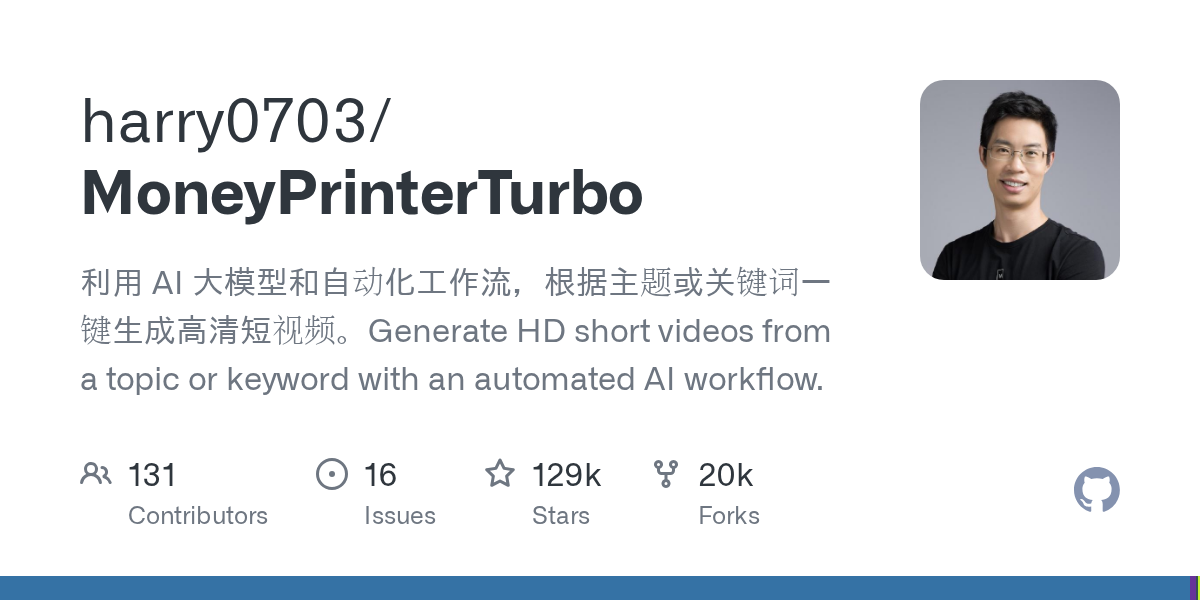
Enter harry0703/MoneyPrinterTurbo, a repository that has rapidly accumulated over 129,100 stars and 20,200 forks. Architecturally, MoneyPrinterTurbo (MPT) is a comprehensive, one-stop AI short video generation tool. It solves the multi-modal orchestration problem by providing a deterministic, state-managed pipeline. You provide a topic or keyword, and the system automatically generates the video script, matches or generates visual materials, synthesizes voiceovers, aligns subtitles, adds background music, and composites the final high-definition video.
The project is blowing up among developers because it fundamentally commoditizes the video production workflow. Instead of being locked into a single vendor, MPT acts as an agnostic routing layer. It natively supports a massive ecosystem of LLMs (including Kimi K3, DeepSeek, OpenAI, Anthropic Claude, and Gemini), TTS providers (like the free Edge TTS, Azure, and MiniMax), and video generation APIs (such as MiniMax H3, Volcengine Seedance, and OpenAI-compatible endpoints). Furthermore, it exposes this pipeline through four distinct interfaces: an AI Agent, a WebUI, a RESTful API, and a CLI, making it trivial to embed into existing automated workflows.
Real-World Field Use Cases: Where This Moves the Needle in the Field
When we evaluate the production viability of an open-source tool, we must look beyond the GitHub stars and analyze how it behaves under real-world constraints. Here are three concrete implementation patterns for MoneyPrinterTurbo.
1. Developer Platform Integration: Embedding into CI/CD and Microservices
- The Everyday Problem: Marketing and growth teams often require hundreds of localized, platform-specific short videos (TikTok, Reels, Shorts) per week. Manually generating these through web interfaces is unscalable, and building a custom rendering pipeline from scratch requires deep FFmpeg and async I/O expertise.
- How It Works in Practice: Engineering teams can deploy MPT as a headless microservice using its built-in API or CLI. By integrating it into an event-driven architecture (e.g., Kafka or AWS SQS), a trigger—such as a new product launch in a CMS—can dispatch a payload containing keywords to the MPT service. MPT then programmatically calls the configured LLM (e.g., DeepSeek) for the script, fetches assets via the Pexels API, and returns an S3-hosted MP4 URL via a webhook callback.
- The Tangible Impact: This transforms video creation from a manual, human-in-the-loop bottleneck into a deterministic, automated CI/CD pipeline, enabling the generation of thousands of localized videos with zero marginal human labor.
2. Concurrency & Memory Footprint: Evaluating P99 Latency Under Load
- The Everyday Problem: Video rendering is inherently CPU and memory-intensive. When scaling automated video generation, concurrent FFmpeg processes can easily cause out-of-memory (OOM) crashes or severe CPU throttling, destroying P99 latency metrics and degrading the reliability of the entire host node.
- How It Works in Practice: MPT’s architecture allows for strategic decoupling. The heavy lifting of AI inference (LLM scripting, TTS generation, AI video generation via MiniMax H3) is offloaded to managed cloud APIs. The local compute footprint is restricted primarily to the final FFmpeg compositing and, optionally, local
faster-whisper transcription. By deploying MPT in containerized environments (using the provided docker-compose.yml) with strict CPU/RAM limits and utilizing GPU passthrough for Whisper, teams can isolate the rendering workload.
- The Tangible Impact: By isolating the I/O-bound API calls from the CPU-bound rendering tasks, engineering teams can achieve predictable P99 latencies, ensuring that batch generation tasks complete reliably without cascading node failures.
3. Build-vs-Buy Adoption Verdict: Operational Trade-offs vs. Managed Cloud
- The Everyday Problem: Enterprise teams often default to managed AI video platforms (like Synthesia or HeyGen) to avoid operational overhead, but quickly encounter vendor lock-in, rigid API rate limits, and exorbitant per-minute rendering costs.
- How It Works in Practice: Adopting MPT represents a strategic "Build" (or rather, "Self-Host") decision. Teams can leverage MPT's compatibility with unified API gateways (like Cloudflare AI Gateway, OneAPI, or LiteLLM) to dynamically route requests to the most cost-effective models at any given time. For instance, using the free Edge TTS combined with a low-cost LLM like DeepSeek V4.1 drastically reduces the unit cost per video.
- The Tangible Impact: While the operational trade-off requires maintaining the deployment infrastructure and monitoring third-party API stability, the financial impact is a reduction in video generation costs by up to 90% compared to closed-source managed alternatives, alongside total control over the data pipeline.
Under the Hood: Architecture & Design Choices
To understand why MoneyPrinterTurbo is effective, we must examine its internal execution pipeline. At its core, MPT is a sophisticated state machine that orchestrates a Directed Acyclic Graph (DAG) of multi-modal tasks. It is not merely a wrapper around a single API; it is an integration layer that normalizes the inputs and outputs of dozens of disparate AI services.
The architecture is built on Python 3.11+ and relies heavily on asynchronous I/O to manage the latency of external API calls, combined with robust subprocess management for FFmpeg operations.
flowchart LR
    %% Define Styles
    classDef input fill:#2d3436,stroke:#74b9ff,stroke-width:2px,color:#fff
    classDef llm fill:#0984e3,stroke:#74b9ff,stroke-width:2px,color:#fff
    classDef asset fill:#00b894,stroke:#55efc4,stroke-width:2px,color:#fff
    classDef audio fill:#e17055,stroke:#fab1a0,stroke-width:2px,color:#fff
    classDef render fill:#6c5ce7,stroke:#a29bfe,stroke-width:2px,color:#fff
    classDef output fill:#d63031,stroke:#ff7675,stroke-width:2px,color:#fff

    %% Nodes
    A[Input: Topic/Keyword]:::input

    subgraph ScriptingPhase["Scripting Phase"]
        B[LLM Router]:::llm
        C{Model Selection}:::llm
        C -->|Kimi K3 / DeepSeek| D[Generate Script & Keywords]:::llm
        C -->|OpenAI / Claude| D
    end

    subgraph AssetAcquisitionPhase["Asset Acquisition Phase"]
        E[Asset Router]:::asset
        F{Source Selection}:::asset
        F -->|Stock APIs| G[Pexels / Pixabay]:::asset
        F -->|AI Video Gen| H[MiniMax H3 / Seedance]:::asset
        F -->|Local| I[User Uploads]:::asset
    end

    subgraph AudioSubtitlePhase["Audio & Subtitle Phase"]
        J[TTS Engine]:::audio
        K[Edge TTS / Azure / MiMo]:::audio
        L[faster-whisper]:::audio
        M[Subtitle Alignment .srt]:::audio
    end

    subgraph CompositingPhase["Compositing Phase"]
        N[FFmpeg Subprocess]:::render
        O[Video Filters & Scaling]:::render
        P[Audio Mixing & BGM]:::render
    end

    Q([Final HD MP4]):::output

    %% Edges
    A --> B
    B --> C
    D --> E
    D --> J
    E --> F
    G --> N
    H --> N
    I --> N
    J --> K
    K --> L
    L --> M
    M --> N
    N --> O
    O --> P
    P --> Q
The Execution Pipeline
- The LLM Routing Layer: The pipeline begins with the LLM router. MPT does not hardcode a single provider. Instead, it implements an adapter pattern that supports native APIs (like Moonshot's Kimi K3, which is explicitly highlighted for its 1M token context and native visual capabilities) as well as OpenAI-compatible endpoints. This allows the system to interface with unified gateways like OneAPI or LiteLLM. The LLM is prompted not just to write a script, but to output structured JSON containing the narration text and corresponding visual search keywords for each scene.
- Asset Acquisition & Generation: Once the script and keywords are generated, the pipeline forks. The text is sent to the TTS engine, while the keywords are sent to the asset router. For visual assets, MPT can query stock APIs (Pexels, Pixabay) or trigger asynchronous AI video generation APIs (like MiniMax H3 or Volcengine Seedance). Handling asynchronous video generation is architecturally complex; MPT must manage polling mechanisms or webhooks to wait for the 4–15 second video clips to render before proceeding.
- Audio Synthesis and Alignment: The text is processed by a TTS provider. MPT's integration of Edge TTS is a critical design choice, providing high-quality, free voice synthesis without requiring API keys, which drastically lowers the barrier to entry. Once the audio file is generated, MPT utilizes
faster-whisper (which benefits significantly from local GPU VRAM) to transcribe the generated audio back into text with precise word-level timestamps, generating the .srt or .ass subtitle files.
- FFmpeg Compositing: The final, and most computationally expensive, step is the assembly. MPT constructs complex FFmpeg filter graphs programmatically. It handles aspect ratio conversions (9:16, 16:9, 1:1), scales and crops the retrieved assets to fit the target resolution, overlays the generated subtitles with customizable styling (font, stroke, background), and mixes the TTS audio track with background music (BGM), applying volume normalization.
Agentic Workflows and Framework Comparisons
It is worth noting that MPT describes itself as offering an "AI Agent" usage mode. In the broader context of agentic engineering, MPT operates as a highly specialized, monolithic workflow. When we compare this to generalized agent frameworks like the Agent Development Kit (ADK), we see a divergence in design philosophy.
The Google ADK (available in Python, TypeScript, Go, Java, and Kotlin) is designed to build, debug, and deploy reliable AI agents at enterprise scale using graph workflows and multi-agent orchestration. ADK allows developers to weave deterministic code with adaptive AI reasoning, creating complex, dynamic execution paths.
MoneyPrinterTurbo, conversely, is a purpose-built pipeline. While it orchestrates multiple models and tools, its execution path is relatively linear and deterministic (Script -> Assets -> Audio -> Video). However, an engineering team utilizing the ADK could easily encapsulate MPT's CLI or API as a custom "Tool" or "Agent Skill" within a larger multi-agent system. For example, a "Research Agent" built in ADK could gather data on a trending topic, pass the synthesized research to a "Director Agent," which then invokes the MoneyPrinterTurbo API to generate the final video artifact.
Hands-On Quickstart & Code Walkthrough
Deploying MoneyPrinterTurbo in a production or local environment requires Python 3.11+ and, ideally, a machine with at least 8GB of RAM (16GB recommended) and a dedicated GPU if you intend to run faster-whisper locally for subtitle alignment.
Based on the official documentation found at harry0703/MoneyPrinterTurbo#readme, here is the standard deployment and execution flow.
1. Installation and Environment Setup
First, clone the repository and install the dependencies. The project supports standard pip as well as modern package managers like uv.
# Clone the repository
git clone https://github.com/harry0703/MoneyPrinterTurbo.git
cd MoneyPrinterTurbo

# Create a virtual environment (recommended)
python3.11 -m venv venv
source venv/bin/activate  # On Windows: venv\Scripts\activate

# Install dependencies
pip install -r requirements.txt
For containerized deployments, MPT provides multiple Docker configurations, including docker-compose.yml for standard CPU usage and docker-compose.gpu.yml for environments with NVIDIA container toolkits enabled.
2. Configuration
Before running the system, you must configure your API keys. MPT uses a TOML configuration file. You will copy the example configuration and populate it with your preferred providers.
cp config.example.toml config.toml
Inside config.toml, you define your LLM provider, TTS settings, and asset sources. For example, to use Kimi (Moonshot AI) for scripting and Edge TTS for audio:
[app]
# Global application settings

[llm]
provider = "moonshot"
api_key = "sk-your-kimi-api-key-here"
model = "moonshot-v1-8k"

[tts]
provider = "edge-tts"
voice = "zh-CN-XiaoxiaoNeural"

[video_source]
provider = "pexels"
api_key = "your-pexels-api-key-here"
3. Execution via CLI
While the WebUI (webui.bat or webui.sh) is excellent for visual configuration, engineers will primarily interact with the cli.py or main.py entry points for programmatic generation.
Here is an example of how to trigger a video generation task directly from the command line, specifying the topic, video format, and language:
# Generate a vertical (9:16) video about "The Future of Clean Energy"
python cli.py \
  --topic "The Future of Clean Energy" \
  --video_format "9:16" \
  --language "English" \
  --duration 30
Under the hood, this CLI command instantiates the asynchronous pipeline, sequentially calling the configured LLM, fetching assets, generating the audio, and finally invoking the local FFmpeg binary to composite the MP4. The output is typically saved in a designated output/ or tasks/ directory, complete with the intermediate files (script JSON, downloaded MP4 clips, generated SRT subtitles) for debugging purposes.
My Honest Verdict: Where It Fits in Your Stack (Pros & Trade-offs)
After a thorough architectural review of the harry0703/MoneyPrinterTurbo/releases and its underlying codebase, here is an objective assessment of where this tool belongs in a modern engineering stack.
The Pros: Where MPT Shines
- Unmatched Ecosystem Flexibility: The greatest strength of MPT is its agnostic routing layer. By supporting everything from OpenAI and Claude to specialized Chinese models like Kimi K3 and DeepSeek, it prevents vendor lock-in. The integration of unified gateways (LiteLLM, OneAPI) means you can dynamically route requests based on cost and rate limits.
- Cost-Efficiency via Edge TTS: The native integration of Edge TTS is a massive win for indie hackers and bootstrapped startups. High-quality text-to-speech is traditionally one of the most expensive components of AI video generation; bypassing this cost entirely changes the unit economics of programmatic video.
- Extensive Interface Options: Providing a WebUI for prompt engineers, a CLI for system administrators, and a REST API for backend developers ensures that MPT can be utilized across the entire organizational stack.
- Transparent Compositing: Because the final assembly is done locally via FFmpeg, engineers have total control over the rendering process. You can inspect the intermediate files, tweak the FFmpeg filter graphs, and debug exact frame alignments—a level of transparency impossible with closed-source SaaS platforms.
The Trade-offs: Current Limitations
- Dependency Fragility: The pipeline is only as reliable as its weakest upstream API. If Pexels changes its rate limits, or if a specific LLM provider experiences an outage, the entire MPT pipeline will fail. Robust error handling, automatic retries, and fallback providers must be meticulously configured in production.
- Compute Bottlenecks: While LLM and TTS tasks are offloaded, FFmpeg compositing is CPU-bound and memory-intensive. Running MPT at high concurrency on a single node will quickly lead to resource exhaustion. Teams must implement queueing systems (like Celery or RabbitMQ) and horizontal scaling to handle batch generation reliably.
- Lack of Granular Timeline Control: MPT is a programmatic generator, not a Non-Linear Editor (NLE). If the AI selects a video clip where the subject is slightly off-center, or if the BGM swells at the wrong moment, correcting it requires regenerating the video or manually editing the output in Premiere/DaVinci. It lacks the granular, frame-by-frame timeline manipulation found in commercial tools.
- State Management Complexity: Compared to building an agent with a framework like the Google ADK, MPT's internal state management is highly specific to video generation. If you need to introduce complex branching logic (e.g., "If the video is about finance, use this specific API; if about nature, use another"), you will find yourself fighting the monolithic nature of the pipeline rather than leveraging a flexible graph workflow.
Final Thoughts
MoneyPrinterTurbo is a masterclass in API orchestration and multi-modal pipeline design. It takes the fragmented, chaotic world of generative AI models and forces them into a deterministic, highly useful output: a rendered MP4. For engineering teams looking to automate content creation, build marketing microservices, or simply experiment with AI video without paying exorbitant SaaS fees, MPT is currently one of the most powerful open-source primitives available. Just ensure your infrastructure is prepared to handle the FFmpeg compute load, and wrap the execution in a robust asynchronous queue.