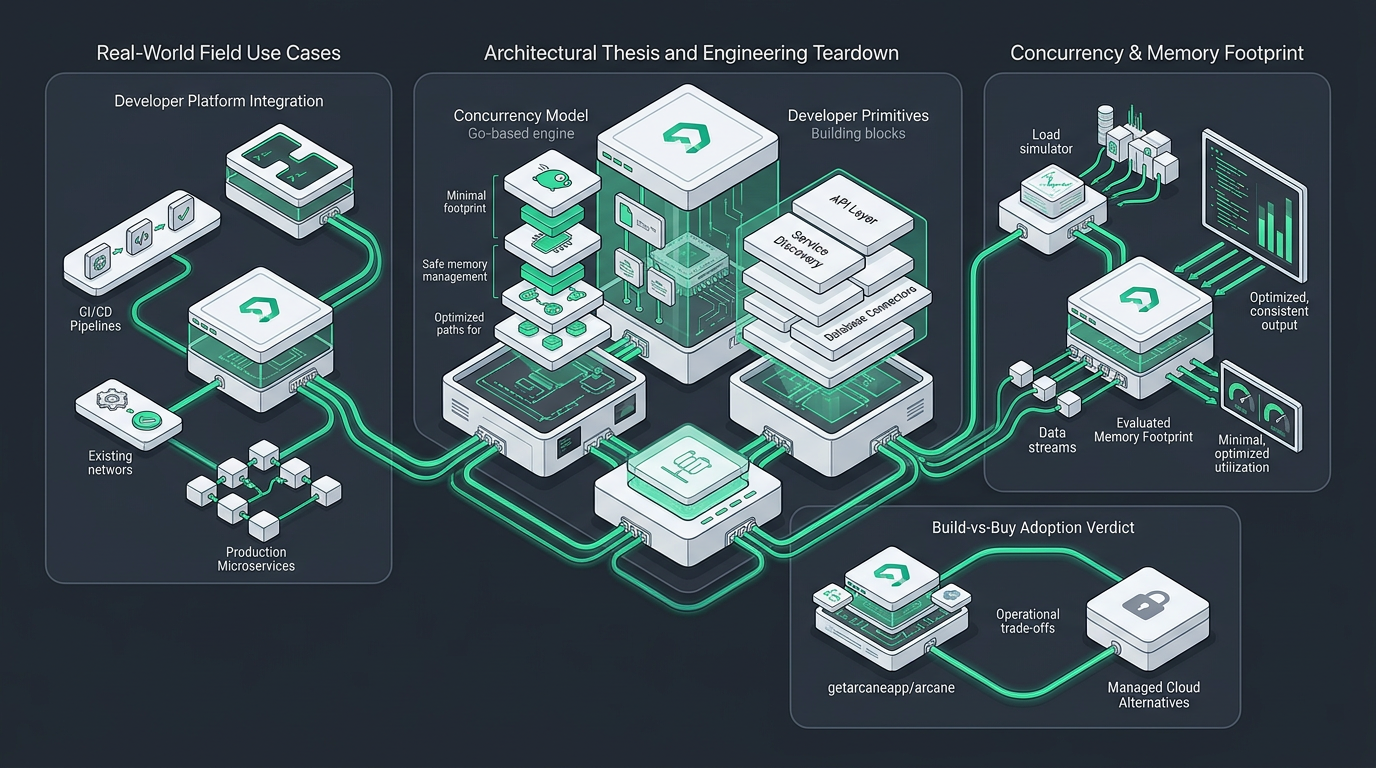
Inside getarcaneapp/arcane: Architecture & Production Teardown — How Does It Work in Production?
TL;DR: Arcane (getarcaneapp/arcane) is a modern, self-hosted container management platform built with a high-performance Go backend and a reactive SvelteKit frontend. Designed to replace legacy tools like Portainer and Watchtower, it provides engineers with a lightweight control plane featuring native GitOps synchronization, dependency-aware auto-updates, and remote agent orchestration for distributed Docker and Podman environments.
What Is Inside getarcaneapp/arcane: Architecture & Production Teardown & Why Is It Blowing Up?
The container orchestration landscape has long been polarized. On one end of the spectrum, Kubernetes offers infinite scalability at the cost of immense operational complexity and cognitive load. On the other end, raw Docker CLI and basic docker-compose commands lack the observability, role-based access control (RBAC), and lifecycle automation required for production environments. For years, Portainer served as the middle-ground standard, but as it grew in scope, many engineers found it increasingly bloated and encumbered by enterprise paywalls for essential features.
Enter getarcaneapp/arcane, a project that has rapidly accumulated over 10,300 stars by rethinking what a container management control plane should look like. Arcane is not trying to be Kubernetes; instead, it perfects the single-node and multi-node Docker/Podman experience. By combining a statically compiled Go backend with a zero-virtual-DOM SvelteKit frontend, Arcane delivers a blisteringly fast, low-footprint platform.
What truly sets Arcane apart—and why it is trending across engineering communities—is its native integration of modern deployment paradigms. It treats Git repositories as the single source of truth for Compose files, natively supports Podman (including Pods and Quadlets), and completely replaces third-party update utilities like Watchtower by implementing its own dependency-aware cron update engine.
To understand where this tool fits into a modern engineering organization, we must examine its application in the field. Here are three real-world use cases demonstrating how Arcane moves the needle in production environments.
Real-World Field Use Cases & Implementation Ideas
1. Developer Platform Integration: Embedding into CI/CD and Microservice Pipelines
- The Everyday Problem: Teams running self-hosted or bare-metal infrastructure often struggle to bridge the gap between their CI/CD pipelines, AI-driven operations, and raw Docker hosts. Triggering deployments or rolling back failed containers usually requires brittle SSH scripts or complex webhook configurations.
- How It Works in Practice: Arcane exposes a comprehensive suite of REST APIs that can be seamlessly integrated into broader internal developer platforms (IDPs). For instance, engineering teams building autonomous operations can leverage frameworks like the Agent Development Kit (ADK) to create intelligent, AI-driven agents. A Go or Python-based ADK agent can continuously monitor Arcane's
/api/health/ready endpoint. If a deployment fails, the agent can interface with Arcane's API to analyze container logs, evaluate the failure state, and automatically trigger a rollback to the previous image hash.
- The Tangible Impact: This transforms Arcane from a passive dashboard into an active, programmable orchestration layer. It reduces manual intervention, accelerates mean time to recovery (MTTR), and allows platform teams to build sophisticated, agentic workflows on top of standard Docker infrastructure.
2. Concurrency & Memory Footprint: Evaluating P99 Latency Under Load
- The Everyday Problem: Legacy container management tools built on Node.js or Java virtual machines often consume hundreds of megabytes of RAM just to idle. On edge devices, IoT gateways, or resource-constrained VPS instances, this control-plane overhead starves actual production workloads of critical CPU cycles and memory.
- How It Works in Practice: Arcane’s backend is written entirely in Go. It compiles down to a single, statically linked binary. Go’s concurrency model, utilizing lightweight goroutines, allows Arcane to handle hundreds of simultaneous tasks—such as streaming real-time logs via WebSockets, polling remote agents over mTLS, and executing vulnerability scans—without blocking the main execution thread.
- The Tangible Impact: The memory footprint remains exceptionally low (often under 50MB), and P99 API latency stays in the low milliseconds even under heavy load. Engineers can confidently deploy Arcane's remote agents to edge nodes without worrying about resource exhaustion, maximizing the compute density of their hardware.
3. Build-vs-Buy Adoption Verdict: Operational Trade-offs vs. Managed Cloud
- The Everyday Problem: Startups and homelab enthusiasts frequently face steep egress fees, compute premiums, and vendor lock-in when using managed serverless container platforms like AWS Fargate or Google Cloud Run. However, repatriating workloads to bare metal usually means sacrificing the "managed" developer experience (automated updates, easy rollbacks, centralized logging).
- How It Works in Practice: Arcane provides a "managed-like" PaaS experience on unmanaged infrastructure. By deploying Arcane's control plane and connecting remote nodes via Arcane Agents, teams get centralized UI-driven management, GitOps synchronization, OpenTelemetry analytics, and OIDC Single Sign-On (SSO) out of the box.
- The Tangible Impact: Organizations achieve the economic benefits of raw compute (bare metal or cheap cloud instances) without inheriting the operational nightmare of manual server management. It strikes the perfect balance in the build-vs-buy equation for teams with predictable workloads or strict data sovereignty requirements.
Under the Hood: Architecture & Design Choices
When we inspect the production topology of Arcane, the architectural decisions reflect a deep understanding of modern systems engineering. The application is logically divided into a high-performance API layer, a reactive client interface, and a distributed execution engine.
The Go Control Plane
At the core of Arcane is a Go-based REST API. Go was selected for its predictable performance, robust standard library, and ease of cross-compilation. The backend is responsible for state management, authentication (including Passkeys, MFA, and OIDC), and orchestrating the various Docker daemons.
A critical design choice in Arcane is its approach to auto-updates. Instead of relying on external tools like Watchtower, Arcane implements an internal cron-based engine. This engine doesn't just blindly pull latest images; it parses the depends_on directives within your docker-compose.yaml files. If a web service depends on a database, Arcane ensures the dependency graph is respected during the update lifecycle, preventing race conditions and application crashes during automated rollouts.
The SvelteKit Frontend
The frontend is built using SvelteKit and TypeScript. Unlike React or Vue, which rely on a virtual DOM to calculate state changes, Svelte compiles components down to highly optimized vanilla JavaScript at build time. This architectural choice is crucial for a container management tool. When streaming thousands of lines of container logs via WebSockets or rendering real-time GPU monitoring metrics, the absence of virtual DOM diffing overhead ensures the UI remains fluid and responsive, avoiding the browser lock-ups common in older management dashboards.
Distributed Agent Topology & Security
Arcane is not limited to a single node. It employs a distributed architecture where the primary control plane communicates with remote agents installed on other servers. To ensure zero-trust security across public networks, communication between the control plane and remote agents is secured via mutual TLS (mTLS). Furthermore, Arcane supports socket proxies, ensuring that the primary application does not need direct root access to the Docker socket, significantly reducing the attack surface.
Here is a structural look at Arcane's internal architecture and execution pipeline:
flowchart LR
    subgraph Clientlayer["Client Layer"]
        UI[SvelteKit Web UI<br/>Zero-vDOM Rendering]
        CLI[Arcane CLI / API Clients]
    end

    subgraph Controlplane["Arcane Control Plane"]
        GoAPI[Go REST API<br/>Goroutine Concurrency]
        GitOps[GitOps Sync Engine]
        Cron[Auto-Update Cron<br/>Dependency DAG Parser]
        Auth[OIDC / MFA Auth]
        DB[(Persistent State)]
    end

    subgraph Executionnodes["Execution Environments"]
        LocalDaemon[Local Docker/Podman Socket]
        RemoteAgent1[Remote Agent 1<br/>Edge Node]
        RemoteAgent2[Remote Agent 2<br/>VPS Node]
    end

    UI -->|HTTP/REST & WebSockets| GoAPI
    CLI -->|HTTP/REST| GoAPI

    GoAPI <--> DB
    GoAPI <--> Auth
    GoAPI --> GitOps
    GoAPI --> Cron

    GitOps --> LocalDaemon
    Cron --> LocalDaemon

    GoAPI -->|Local Socket Proxy| LocalDaemon
    GoAPI -->|mTLS Encrypted| RemoteAgent1
    GoAPI -->|mTLS Encrypted| RemoteAgent2
The platform also integrates natively with modern observability stacks, offering OpenTelemetry analytics and GPU monitoring, making it a first-class citizen in enterprise environments that require deep introspection into hardware utilization.
Hands-On Quickstart & Code Walkthrough
Arcane provides a streamlined, developer-friendly setup process. Whether you are deploying it for production or spinning up a local development environment to contribute to the codebase, the tooling is heavily optimized.
Based on the official documentation and the repository's CONTRIBUTING.md, here is how you can get Arcane running locally. The development environment utilizes Docker Compose, Vite+ for frontend hot-module replacement (HMR), and Air for Go backend hot-reloading.
Prerequisites
Before starting, ensure you have the following installed on your workstation:
- Docker & Docker Compose
- Vite+ (
curl -fsSL https://vite.plus | bash)
golangci-lint v2 (for Go linting and formatting)just (a modern command runner)
1. Cloning and Starting the Environment
To spin up the full stack, clone the repository and use the provided development script. This script automatically handles dependencies, sets up persistent volumes, and starts the services with hot-reload enabled.
# Clone the repository
git clone https://github.com/getarcaneapp/arcane.git
cd arcane

# Start the development environment
./scripts/development/dev.sh start
Once executed, the environment exposes two primary endpoints:
- Frontend:
http://localhost:3000 (SvelteKit with HMR)
- Backend:
http://localhost:3552 (Go REST API)
2. Validating the Deployment & API
Arcane's backend provides robust health check endpoints, which are particularly useful when integrating with external load balancers or orchestrators. You can verify the process liveness and database/Docker readiness using standard curl commands:
# Check process liveness
curl -f http://localhost:3552/api/health

# Check full system readiness (Database & Docker socket connected)
curl -f http://localhost:3552/api/health/ready
Note: The /api/health/ready endpoint will return a 503 Service Unavailable until both the internal database and the Docker daemon successfully answer the ping.
3. Developer Workflow & Code Quality
Arcane uses just to simplify complex build and test commands. If you are modifying the Go backend or the SvelteKit frontend, you can easily run quality checks or rebuild specific components.
# View all available Justfile targets
just --list

# Run formatting and linting across the codebase
just format all --check
just lint js

# Alternatively, use Vite+ for frontend checks
vp fmt --check
vp check

# Rebuild only the backend binary
just build single backend
If you need to debug the underlying Docker Compose configuration that Arcane uses for its development environment, you can inspect the generated config:
docker compose -f docker/compose.dev.yaml -p arcane-dev config
This developer experience is incredibly polished. By wrapping complex Docker commands in intuitive shell scripts and just targets, the maintainers have drastically lowered the barrier to entry for open-source contributors.
My Honest Verdict: Where It Fits in Your Stack (Pros & Trade-offs)
After evaluating the architecture, the source code, and the Releases trajectory, it is clear why Arcane is capturing the attention of the self-hosted and enterprise engineering communities. However, like any architectural decision, adopting Arcane comes with specific trade-offs.
The Pros: Where Arcane Shines
- Unmatched Performance and UX: The combination of Go and SvelteKit results in a UI that feels instantaneous. Unlike older Java or Node-based dashboards that lag when rendering hundreds of containers, Arcane handles massive lists and real-time log streams effortlessly.
- Native GitOps & Lifecycle Management: By allowing engineers to point Arcane directly at a Git repository containing
docker-compose.yaml files, it enforces Infrastructure as Code (IaC) principles. The built-in, dependency-aware auto-update mechanism completely deprecates the need for fragile, third-party updaters like Watchtower.
- Comprehensive Feature Set: Arcane doesn't just stop at basic Docker management. Its support for Podman (Pods and Quadlets), Docker Swarm, OIDC SSO, and OpenTelemetry analytics makes it a viable choice for serious, compliance-bound production environments.
- Security Posture: Features like mTLS for remote agents, socket proxies to protect the Docker daemon, and publicly available Software Bill of Materials (SBOMs) at
getarcane.app/sbom demonstrate a mature approach to supply chain and operational security.
The Trade-offs: Current Limitations
- The Self-Hosted Maintenance Burden: While Arcane simplifies Docker management, you are still responsible for the underlying infrastructure. If the host operating system fails, or if the Docker daemon crashes, Arcane cannot magically migrate your workloads to another server in the way a managed Kubernetes service (like EKS or GKE) would.
- Not a Kubernetes Replacement: Arcane is exceptional at managing Compose stacks and Swarm clusters, but it lacks the advanced scheduling, automated bin-packing, and complex ingress routing capabilities of Kubernetes. If your architecture requires dynamic scaling of microservices based on custom metrics across thousands of nodes, Arcane is not the right tool.
- Ecosystem Maturity: While growing rapidly, Arcane's plugin ecosystem and third-party integrations are still evolving compared to legacy giants. You may need to write custom API glue (perhaps using tools like the ADK) to integrate it perfectly into highly bespoke enterprise pipelines.
Final Thoughts
If you are reading the README and wondering if it is time to migrate away from Portainer, the answer is a resounding yes. Arcane represents the modern standard for container management. It strips away the bloat, embraces declarative GitOps workflows, and provides a secure, agent-driven architecture that scales elegantly from a single Raspberry Pi to a fleet of distributed production servers. For teams that want the simplicity of Docker Compose with the operational rigor of a modern platform, Arcane is currently the best-in-class open-source solution.