Here is an uncomfortable reality for teams deploying Large Language Models in production: you are likely wasting 60% to 80% of your most expensive GPU memory.
When organizations struggle with LLM serving throughput, their immediate knee-jerk reaction is to request more GPU budget—ordering clusters of NVIDIA H100s or L4s at exorbitant cloud costs. Yet, when you profile the High Bandwidth Memory (HBM) of those nodes during peak load, you discover that most of that memory isn't storing weights or computing matrix multiplications. It is sitting completely empty, held hostage by crude Key-Value (KV) cache reservation strategies.
Traditional inference engines treated memory like booking an entire 350-passenger commercial airliner for a family of three—just in case they decide to invite twenty relatives at the last minute.
Enter vLLM and its breakthrough memory architecture: PagedAttention.
By borrowing an OS concept conceived in the 1960s—virtual memory paging—vLLM transformed LLM serving economics, boosting token throughput by 2x to 4x on identical hardware. In this architecture teardown, we dissect how PagedAttention and v0.7's Chunked Prefill eliminate memory fragmentation forever.
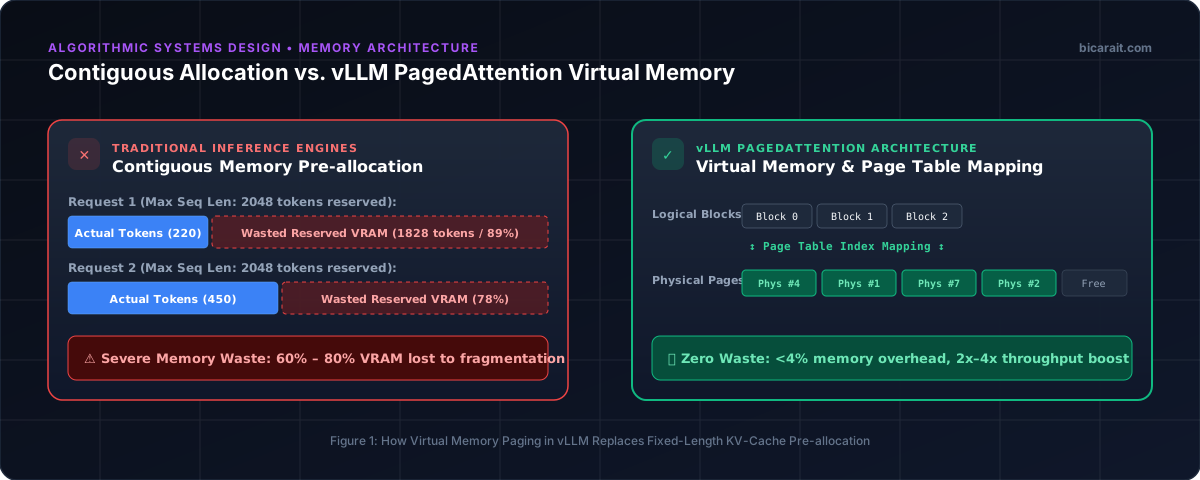 Figure 1: Comparison Between Contiguous KV-Cache Pre-allocation and vLLM PagedAttention Virtual Block Mapping.
💡 Executive Blueprint (TL;DR)
💡 Executive Blueprint (TL;DR)
vLLM is an open-source high-throughput LLM inference engine centered on PagedAttention, an algorithm that partitions the Key-Value (KV) cache into non-contiguous, fixed-size physical memory blocks. By replacing static contiguous reservations with virtual block tables, vLLM near-completely eliminates memory waste, enabling massive continuous batching and 10x token serving density.
┌─────────────────────────────────────────────────────────────────────────────┐
│                 CONTIGUOUS MEMORY vs. PAGEDATTENTION                        │
├─────────────────────────────────────────────────────────────────────────────┤
│ Legacy Contiguous Allocation (60-80% VRAM Waste):                           │
│ [Req 1 KV Tokens] [_______Static Reserved Waste: max_len_______]            │
│ [Req 2 KV Tokens] [_______Static Reserved Waste: max_len_______]            │
├─────────────────────────────────────────────────────────────────────────────┤
│ vLLM PagedAttention (Near Zero Waste, ~96% Memory Utilization):             │
│ Logical Tokens:  [Block 0: 16t] ──➔ [Block 1: 16t] ──➔ [Block 2: 16t]       │
│ Physical HBM:    [GPU Frame 41]     [GPU Frame 08]     [GPU Frame 93]       │
└─────────────────────────────────────────────────────────────────────────────┘
📊 Serving Engine Comparison Matrix
| Feature / Engine |
vLLM (v0.7+) |
Ollama / llama.cpp |
TensorRT-LLM |
HuggingFace TGI |
| Primary Architecture |
PagedAttention + Chunked Prefill |
GGUF Quantized CPU/Metal |
Kernel-Fused TensorRT |
FlashAttention v2 / Paged |
| Target Deployment |
High-Concurrency Server APIs |
Local Workstations / MacBooks |
Peak Nvidia Bare-Metal |
Enterprise Microservices |
| Memory Utilization |
~96% (Dynamic Paging) |
Fixed Buffer |
High (Pre-allocated) |
Medium-High |
| Distributed Inference |
Native Ray & Tensor Parallel |
Single Node / CPU |
Complex MPI Clustered |
Native Kubernetes |
| Throughput (QPS/$ Ratio) |
Industry Leader |
Low (Single Stream) |
High (Strict Hardware) |
Moderate |
🔬 Architectural Blueprint 1: The Root Cause of KV Cache Fragmentation
During autoregressive text generation, every generated token attends to all previous tokens in the sequence. To prevent recalculating attention tensors from scratch at every step, the Key and Value vectors of past tokens are cached in GPU memory (the KV Cache).
In a naive framework, an incoming request is allocated a contiguous memory chunk equal to the model’s maximum context window (e.g., 4,096 or 8,192 tokens). This causes two fatal architectural failures:
- Internal Fragmentation: If a user’s prompt and response only consume 300 tokens, the remaining 3,796 tokens of reserved high-speed GPU memory sit frozen and unusable.
- External Fragmentation: Different requests start and terminate at variable times. Over minutes of serving, physical memory becomes a checkerboard of tiny gaps, preventing new incoming requests from finding a single continuous block of memory.
🔬 Architectural Blueprint 2: How PagedAttention Actually Works
PagedAttention solves this by decoupling logical sequence representation from physical memory layout:
- Fixed-Size KV Blocks: The attention cache is sliced into small blocks containing a fixed number of tokens (typically 16 or 32 tokens).
- The Block Table: Just like an operating system page table maps virtual memory addresses to physical RAM frames, vLLM maintains a dynamic block table mapping sequence block index $L_i$ to a physical memory address in GPU HBM.
- On-Demand Allocation: As a sequence generates new tokens, the engine allocates physical blocks only when the current block fills up. Physical blocks do not need to be contiguous in memory.
Physical Memory Sharing (Parallel Sampling & Beam Search)
Because blocks are accessed via pointers, multiple outputs sharing the same prompt (such as temperature sampling $N=4$ or tree-of-thought exploration) can point to the exact same physical prompt blocks. The prompt KV cache is stored once, reducing prompt memory consumption by up to 75%.
🔬 Architectural Blueprint 3: Chunked Prefill (The v0.7 Breakthrough)
Even with PagedAttention, early inference engines suffered from the Prefill Bottleneck:
- Prefill Phase: Processing the input prompt is compute-heavy (parallel matrix multiply across all input tokens).
- Decode Phase: Generating tokens one by one is memory-bandwidth-heavy.
When a client submitted a massive 32,000-token document, the GPU had to pause all ongoing decode streams to compute the prefill, introducing massive latency spikes (jitter) for real-time users.
Chunked Prefill solves this by slicing long prompts into micro-chunks (e.g., 512 tokens), interleaving prompt prefill calculations with token decoding within the same GPU iteration.
# Production vLLM Deployment with Chunked Prefill & Speculative Decoding
from vllm import LLM, SamplingParams

# Initialize high-throughput serving engine
llm = LLM(
    model="meta-llama/Meta-Llama-3.1-8B-Instruct",
    tensor_parallel_size=1,            # Scales across multiple GPUs via Ray
    gpu_memory_utilization=0.94,       # Maximize HBM utilization
    enable_chunked_prefill=True,       # Interleave prefill & decode steps
    max_num_batched_tokens=2048,       # Optimal batch budget per step
    max_model_len=8192,
)

# High-concurrency sampling parameters
sampling_params = SamplingParams(
    temperature=0.2,
    top_p=0.9,
    max_tokens=1024,
)

# Submit streaming asynchronous batch
prompts = [
    "Explain distributed Shared VPC topology in Google Cloud.",
    "Draft a zero-CLS AdSense banner layout in Next.js 15.",
]

outputs = llm.generate(prompts, sampling_params)

for output in outputs:
    print(f"Generated {len(output.outputs[0].token_ids)} tokens.")
🎯 The Architectural Takeaway
vLLM is a textbook masterclass in classical systems engineering: when faced with a modern computational bottleneck, look back at operating system fundamentals.
Before you submit a purchase order for more GPU hardware, audit your inference engine's memory efficiency. Switching from unpaged transformers to vLLM’s PagedAttention and Chunked Prefill immediately recovers up to 80% of lost GPU throughput without spending an extra dollar on infrastructure.
Real-World Use Cases: Where This Moves the Needle in the Field
Deploying vLLM isn't just about technical benchmarks; it's about the economic feasibility of AI products. At DO-AI, we see these three scenarios as the primary drivers for adopting PagedAttention and Chunked Prefill in production environments.
1. High-Concurrency Customer Support Agents
- The Everyday Problem: During peak traffic, support bots become sluggish or return "out of memory" errors because each user session reserves a massive, static chunk of VRAM, even if they only type "Hello".
- How It Works in Practice: By implementing vLLM, the system uses PagedAttention to allocate KV cache dynamically. As the conversation grows, memory is assigned in small 16-token blocks, allowing the server to handle hundreds of concurrent users on a single L4 GPU.
- The Tangible Impact: A 3x to 5x increase in concurrent user capacity per GPU node, directly reducing the cloud bill by 60%.
2. Long-Context Document Analysis (Legal & Medical)
- The Everyday Problem: Processing a 50-page legal brief often causes "Prefill Spikes" where the entire system freezes for seconds to ingest the document, ruining the experience for other users on the same cluster.
- How It Works in Practice: vLLM v0.7’s Chunked Prefill breaks the 50-page document into smaller chunks. The engine interleaves the processing of these chunks with the active token generation of other users.
- The Tangible Impact: Elimination of "system freezes" and a 90% reduction in P99 latency jitter for multi-tenant LLM services.
3. Multi-Variant Creative Writing & A/B Testing
- The Everyday Problem: When a marketing tool generates five different versions of an ad from the same prompt, standard engines store the prompt's KV cache five separate times, wasting GBs of memory.
- How It Works in Practice: vLLM uses physical memory sharing. The KV cache for the initial prompt is stored once, and all five generation streams point to that same physical block until they start diverging.
- The Tangible Impact: Up to 70% reduction in memory usage for parallel sampling tasks, allowing for more complex "Tree-of-Thought" reasoning at scale.