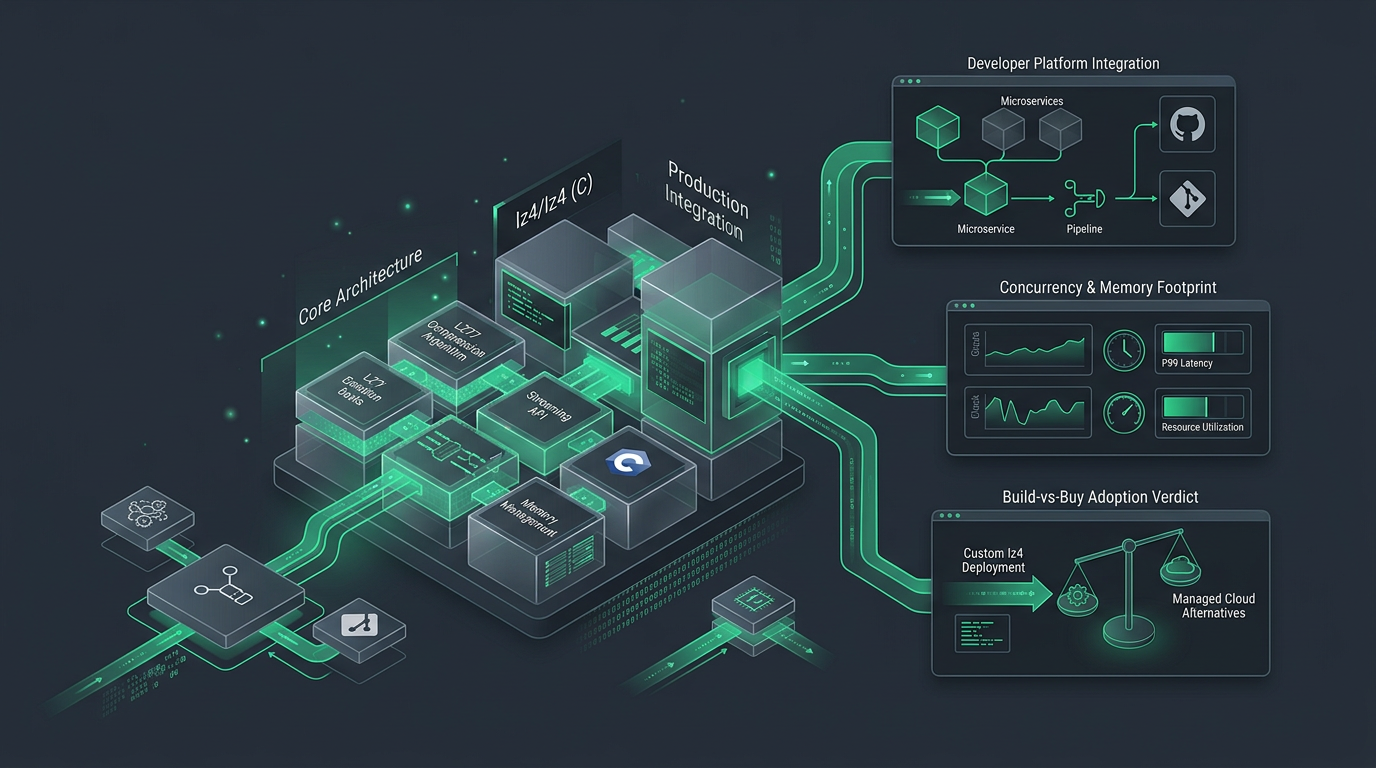
Inside lz4/lz4: Architecture & Production Teardown — How Does It Work in Production?
TL;DR: LZ4 is an extremely fast, lossless compression algorithm designed to operate at the physical limits of RAM bandwidth, delivering decompression speeds of multiple gigabytes per second per core. For systems engineers building high-throughput data pipelines, real-time microservices, or stateful AI orchestration layers, LZ4 provides a critical infrastructure primitive that drastically reduces memory footprint and network I/O without introducing CPU bottlenecks.
What Is Inside lz4/lz4: Architecture & Production Teardown & Why Is It Blowing Up?
In the modern systems engineering landscape, the fundamental physics of compute have shifted. CPU processing power has scaled exponentially, while memory access speeds and network bandwidth have struggled to keep pace. Moving data across a network boundary or fetching it from main memory is now significantly more expensive in terms of latency than performing mathematical operations on that data. This architectural reality is exactly why https://github.com/lz4/lz4 has become a foundational component in nearly every major data-intensive software stack today.
LZ4 is a lossless compression algorithm engineered specifically for extreme speed. Unlike legacy compression formats that prioritize the absolute smallest file size at the expense of heavy CPU utilization, LZ4 is designed to be virtually transparent to the host system. It provides compression speeds exceeding 500 MB/s per core and scales linearly with multi-core CPUs. However, its true engineering marvel lies in its decoder. LZ4 features an extremely fast decompression engine capable of multiple GB/s per core, typically bottlenecked only by the physical RAM speed limits of the multi-core systems it runs on.
The project has garnered massive adoption—boasting over 12,800 stars and 1,700 forks on GitHub—because it offers developers a highly tunable primitive. Engineers can dynamically adjust compression speed by selecting an "acceleration" factor, which trades a fraction of the compression ratio for even faster execution. Conversely, for scenarios requiring better storage efficiency, the repository provides a high-compression derivative known as LZ4_HC. This variant trades CPU time during the compression phase for an improved compression ratio, yet crucially maintains the exact same multi-GB/s decompression speed as the default algorithm.
The open-source community, with special thanks noted in the repository to Takayuki Matsuoka (@t-mat) for exceptional first-class support, has built an ecosystem around this tool. It is dual-licensed, providing the core LZ4 library under the permissive BSD 2-Clause license for seamless enterprise embedding, while the lz4 command-line utility is distributed under the GPL-2.0-or-later license.
Real-World Field Use Cases: Where This Moves the Needle in the Field
To understand why LZ4 is deployed so ubiquitously, we must examine how it solves concrete engineering problems in production environments.
1. Developer Platform Integration: Embedding into CI/CD and Microservice Pipelines
- The Everyday Problem: In large-scale microservice architectures and CI/CD pipelines, massive amounts of JSON payloads, build artifacts, and telemetry data are constantly transmitted across the network. Uncompressed, this data saturates network interface cards (NICs) and inflates cloud egress costs. Traditional compression like zlib reduces the payload size but introduces severe CPU spikes, slowing down the actual application logic.
- How It Works in Practice: Platform engineers embed the LZ4 library directly into their RPC frameworks or message brokers (like Kafka or RabbitMQ). By utilizing the
lz4frame.h API, data streams are chunked into independent blocks and compressed on the fly. Because LZ4 compresses at >500 MB/s per core, the CPU overhead is negligible, and the compressed payload is transmitted across the network in a fraction of the time.
- The Tangible Impact: Network transit times are drastically reduced, and CPU utilization remains flat. Microservices can handle higher requests-per-second (RPS) because they spend less time blocked on network I/O and less time burning CPU cycles on heavy compression algorithms.
2. Concurrency & Memory Footprint: Evaluating P99 Latency Under Load
- The Everyday Problem: High-throughput systems, such as in-memory caches (e.g., Redis clusters) or real-time bidding engines, suffer from P99 latency spikes when garbage collection kicks in or when memory bandwidth is exhausted by concurrent threads trying to read large objects.
- How It Works in Practice: Engineers apply LZ4 compression to objects before writing them to the cache. When a concurrent read request hits the cache, the data is fetched and decompressed. Because LZ4 decompression operates at RAM speed limits (often exceeding 4950 MB/s), the decompression phase is effectively invisible to the application's latency budget. For cold data, teams can dynamically switch to LZ4_HC to save memory space, knowing that when the data is eventually read, it will decompress just as fast as the default LZ4 data.
- The Tangible Impact: The memory footprint of the cache is reduced by roughly 50% (given LZ4's typical ~2.1x compression ratio), allowing twice as much data to fit in the same hardware footprint. Concurrency is improved because smaller objects mean fewer cache line evictions and reduced memory bus contention, stabilizing P99 latencies under heavy load.
3. Build-vs-Buy Adoption Verdict: Operational Trade-offs in AI and Cloud Workloads
- The Everyday Problem: When building complex, stateful applications—such as autonomous AI agents—managing the context window and state events becomes a massive operational burden. Managed cloud databases charge heavily for storage and I/O operations.
- How It Works in Practice: Consider teams building graph workflows and multi-agent collaborative systems using frameworks like the Agent Development Kit (ADK). These agents generate massive amounts of conversational context, memory artifacts, and state events. Instead of buying larger managed database tiers to handle the I/O, engineering teams can implement LZ4 at the application layer. By compressing agent state before writing to the database, they reduce the I/O payload. Furthermore, LZ4's dictionary compression feature can be utilized by feeding it a schema of common AI state structures, drastically improving compression on small JSON state objects.
- The Tangible Impact: Teams can opt for smaller, more cost-effective database instances (the "Build" optimization) rather than paying a premium for higher-tier managed services (the "Buy" penalty). The operational trade-off leans heavily in favor of LZ4 because the CPU cost of compression is dwarfed by the savings in cloud I/O and storage costs.
Under the Hood: Architecture & Design Choices
To fully grasp how LZ4 achieves its performance characteristics, we must look at its internal architecture and the specific design choices made in its implementation. You can explore the full documentation overview at https://github.com/lz4/lz4#readme.
At its core, LZ4 is an LZ77-type byte-oriented compression algorithm. It works by finding repeated sequences of data and replacing them with a reference (a match) to the previous occurrence. The critical architectural choice in LZ4 is its strict adherence to simplicity in the match-finding and encoding phases. It does not use entropy coding (like Huffman coding, which zlib uses) because entropy coding requires multiple passes over the data and complex bit-level manipulation, which destroys CPU cache locality and pipeline efficiency.
Block vs. Frame Architecture
The repository explicitly separates its architecture into two distinct formats, documented in doc/lz4_Block_format.md and doc/lz4_Frame_format.md.
- The Block Format (
lz4.h): This is the raw compression engine. It takes a single, contiguous block of memory and compresses it. It is entirely stateless and unmanaged. If you pass it a 1MB buffer, it compresses that 1MB buffer. However, it has no concept of file headers, checksums, or stream continuation.
- The Frame Format (
lz4frame.h): Because arbitrarily long files or continuous network data streams cannot be loaded into a single memory block, LZ4 provides the Frame API. This layer organizes multiple compressed blocks into a cohesive frame. It handles the streaming requirements, injecting magic numbers, block sizes, and optional checksums to ensure data integrity across interoperable versions of LZ4.
Dictionary Compression and Small Data
One of the most powerful architectural features of LZ4 is its support for dictionary compression, accessible via both the API and the CLI (-D flag). Standard compression algorithms struggle with small files (e.g., < 4KB) because they haven't processed enough data to build a history of repeated patterns.
LZ4 allows engineers to ingest any input file as a dictionary to pre-populate the algorithm's match history. Architecturally, while you can pass a large file, LZ4 strictly uses only the final 64 KB of the dictionary. This is a deliberate design choice: LZ4's internal sliding window for match references is exactly 64 KB. By limiting the dictionary to this size, the algorithm ensures that memory lookups remain entirely within the CPU's L1/L2 cache, preventing costly main memory fetches. This capability is fully compatible with the Zstandard Dictionary Builder, allowing teams to train optimal dictionaries on their specific data schemas to drastically improve compression ratios on small payloads.
Execution Pipeline Diagram
Below is a representation of the LZ4 execution pipeline, illustrating how data flows through the Frame API, is chunked, and processed by either the default or High Compression (HC) engines.
flowchart LR
    A[Raw Data Stream / File] --> B{Frame API: lz4frame.h}
    B --> C[Block Chunk 1]
    B --> D[Block Chunk 2]
    B --> E[Block Chunk N]

    C --> F{LZ4 Core Engine}
    D --> F
    E --> F

    J[(Dictionary 64KB Window)] -.->|Pre-populate Matches| F

    F -->|Acceleration Factor| G[LZ4 Default Engine]
    F -->|CPU Trade-off| H[LZ4_HC Engine]

    G --> I[Compressed Frame Output]
    H --> I
Hands-On Quickstart & Code Walkthrough
Integrating LZ4 into a systems engineering project is straightforward, thanks to its adherence to standard C build conventions and broad package manager support.
Installation via Make
For Linux and Unix-like environments, the repository provides a robust Makefile. It supports standard GNU Makefile conventions, which is critical for systems engineers building automated deployment pipelines. This includes support for staged installs (DESTDIR), directory redirection, and command redefinition. It is also fully compatible with parallel builds (-j#) to speed up compilation.
# Clone the repository and build from source
git clone https://github.com/lz4/lz4.git
cd lz4

# Compile the library and CLI using parallel jobs
make -j4

# Install the library and binaries (requires root)
sudo make install
Installation via vcpkg (C/C++ Dependency Management)
For cross-platform C/C++ projects, particularly those on Windows or those standardizing on Microsoft's tooling, LZ4 can be installed using the vcpkg dependency manager. The LZ4 port in vcpkg is actively maintained by Microsoft team members and community contributors.
# Clone and bootstrap vcpkg
git clone https://github.com/Microsoft/vcpkg.git
cd vcpkg
./bootstrap-vcpkg.sh

# Integrate with your build environment
./vcpkg integrate install

# Install the LZ4 library
./vcpkg install lz4
Alternative build systems, including CMake, Meson, and Visual Studio project files, are natively provided in the build/ directory of the repository. Furthermore, as noted in the repository's packaging status, most Linux distributions bundle LZ4 directly, allowing easy installation of both liblz4 and the lz4 CLI via apt, yum, or pacman.
Code Walkthrough: The C API
When writing C/C++ code, you will primarily interact with three headers: lz4.h for raw block compression, lz4hc.h for high compression blocks, and lz4frame.h for streaming data.
While the repository documentation details the full API, a conceptual implementation of compressing a simple block using lz4.h looks like this:
#include <stdio.h>
#include <string.h>
#include "lz4.h"

int main() {
    const char* src = "This is a test string that we want to compress using the LZ4 block API. It needs to be long enough to show some compression.";
    int src_size = (int)strlen(src) + 1; // Include null terminator

    // Calculate the maximum possible size of the compressed data
    int max_dst_size = LZ4_compressBound(src_size);
    char* compressed_data = (char*)malloc(max_dst_size);

    // Compress the data
    // LZ4_compress_default returns the actual compressed size, or 0 on error
    int compressed_size = LZ4_compress_default(src, compressed_data, src_size, max_dst_size);

    if (compressed_size > 0) {
        printf("Successfully compressed %d bytes down to %d bytes.\n", src_size, compressed_size);
    } else {
        printf("Compression failed.\n");
    }

    // Decompress the data
    char* decompressed_data = (char*)malloc(src_size);
    int decompressed_size = LZ4_decompress_safe(compressed_data, decompressed_data, compressed_size, src_size);

    if (decompressed_size > 0) {
        printf("Successfully decompressed back to %d bytes: %s\n", decompressed_size, decompressed_data);
    }

    free(compressed_data);
    free(decompressed_data);
    return 0;
}
Beyond the C reference source, the community maintains ports in multiple languages including Java, C#, Python, Perl, and Ruby, ensuring that LZ4 can be utilized regardless of your primary application stack.
My Honest Verdict: Where It Fits in Your Stack (Pros & Trade-offs)
When evaluating infrastructure primitives, we must look at objective benchmark data. The repository provides a comprehensive benchmark using lzbench v2.4.1, compiled with GCC v13.3.0 on an Ubuntu 24.04 Linux system with a Core i7-9700K CPU, evaluating the Silesia Corpus in single-thread mode. You can track performance improvements across different releases at https://github.com/lz4/lz4/releases.
The Pros: Unrivaled Decompression Throughput
The most striking data point from the benchmarks is LZ4's decompression speed.
- LZ4 default (v1.11.0): 770 MB/s compression | 4950 MB/s decompression | Factor: 2.112
- LZ4 HC -9 (v1.11.0): 40 MB/s compression | 4800 MB/s decompression | Factor: 2.717
To put this in perspective, a raw memory copy (memcpy) on this hardware achieves 13,700 MB/s. LZ4 is decompressing data at over 36% of the absolute physical limit of the machine's memory bandwidth.
When compared to legacy algorithms like zlib deflate 1.3.2 (which manages a mere 110 MB/s compression and 410 MB/s decompression), LZ4 is in an entirely different class of operational efficiency. Even against Google's Snappy (520 MB/s comp, 1350 MB/s decomp), LZ4 default is significantly faster in both directions while achieving a comparable compression ratio (2.112 vs 2.090).
The inclusion of LZ4_HC is a massive architectural advantage. It allows engineers to compress data asynchronously in background workers (trading CPU time for a 2.717 compression ratio at 40 MB/s) while guaranteeing that the critical-path read operations will still decompress at an astonishing 4800 MB/s.
The Trade-offs: Compression Ratio vs. Zstandard
The primary trade-off when adopting LZ4 is the absolute compression ratio. If your system is strictly bottlenecked by storage capacity or long-haul WAN network costs rather than CPU or memory bandwidth, LZ4 might not be the optimal choice.
Looking at the benchmark:
- Zstandard 1.5.7 -1: 510 MB/s compression | 1570 MB/s decompression | Factor: 2.896
Zstandard (built by the same original author as LZ4) achieves a significantly higher compression ratio (2.896 vs 2.112) while still maintaining very respectable speeds. If you are archiving logs to AWS S3 or transmitting data across expensive cross-region links, the extra 30-40% space savings provided by Zstandard will translate directly into massive cost reductions, making Zstandard the better choice for cold storage or heavy network transit.
Final Stack Placement
LZ4 belongs in the hot path of your architecture. It is the undisputed king of ephemeral data compression. You should deploy LZ4 in your stack for:
- In-Memory Caches: Compressing payloads before writing to Redis or Memcached.
- RPC and Message Buses: Compressing Kafka messages, gRPC payloads, or internal microservice JSON traffic.
- Real-Time State Management: Serializing high-frequency state changes in gaming servers, high-frequency trading platforms, or AI agent memory loops.
If your engineering team is building systems where CPU cycles are precious, latency must be deterministic, and memory bandwidth is the primary constraint, LZ4 is not just a good choice—it is the mathematically optimal primitive for the job.