News Flash: NVIDIA Introduced VFlash, New NVIDIA Cosmos 3, & How Primary Compute Markets?
1. NVIDIA VFlash: Accelerating Physical AI via Parallel Geometric Decoding
The News Highlight:
NVIDIA Research has introduced VFlash, a groundbreaking generalist decoding framework designed to transition Vision-Language Models (VLMs) into "System-1" thinkers for physical AI. Unlike traditional autoregressive models that generate coordinate tokens one by one—a process that is computationally expensive and slow for real-time robotics—VFlash utilizes a parallel decoding approach. By exploiting the known geometric structure of visual primitives like 3D waypoints and trajectories, VFlash allows robots and autonomous vehicles to "think" in visual plans rather than just text, enabling significantly faster and more accurate perception-to-action loops.
- Parallel Primitives: Replaces token-by-token generation with a lightweight drafter that produces complete visual primitives (boxes, points, trajectories) in a single parallel draft.
- Performance Gains: Achieves up to 5x faster robot inference on NVIDIA Thor and Spark platforms compared to standard autoregressive methods.
- Spatial Accuracy: Delivers up to 61% lower error in 3D waypoint prediction relative to autoregressive targets by utilizing structured geometric priors.
- Versatile Output Support: Supports variable output lengths and rich data types, including 2D/3D trajectories for manipulation and driving (e.g., NAVSIM, Waymo, and Alpamayo requirements).
DO-AI Analysis:
From an architectural standpoint, VFlash represents a critical shift from "LLM-centric" robotics to "Geometry-centric" physical AI. The bottleneck in embodied AI has long been the latency of autoregressive decoding; a robot cannot wait for a sequence of tokens to finish before adjusting its grip. By treating trajectories as structured primitives rather than arbitrary sequences, NVIDIA is effectively moving the "compute heavy" reasoning to a parallelized drafting layer. For engineering teams, the takeaway is clear: for real-time edge applications, stop forcing spatial data into text-based tokenization schemes and start leveraging the inherent structural priors of the physical world to achieve low-latency "System-1" responsiveness.
2. NVIDIA Releases Cosmos 3: 16B Open Models for Interactive World Simulation
The News Highlight:
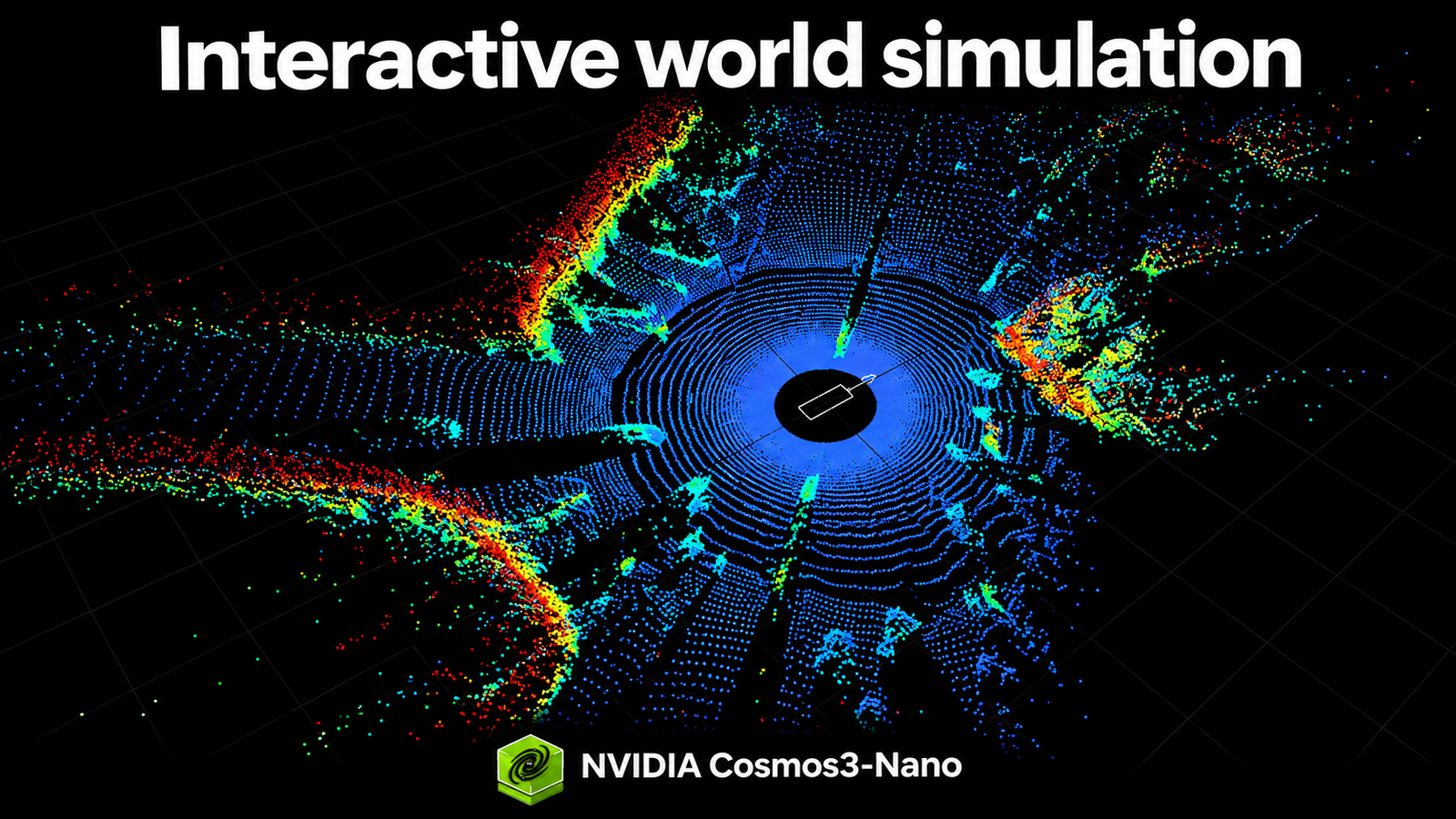
NVIDIA has expanded its Cosmos 3 platform by releasing four new open-weight "Nano" models, each featuring 16 billion trainable parameters, specifically designed for interactive world simulation. These models act as neural simulators, capable of generating photorealistic video, multi-sensor driving data, and synchronized LiDAR observations from simple simulator controls or actions. By providing open-weight checkpoints, NVIDIA is enabling researchers and developers to build high-fidelity, reactive environments for training autonomous vehicles and bimanual robots without the prohibitive costs of massive real-world data collection.
- Four Specialized Checkpoints: Includes
Cosmos3-Nano-Transfer-Auto (multi-view driving data), Sim-Auto (synchronized camera/LiDAR), Sim-Transfer (physics-to-RGB), and Sim-Bimanual (action-to-video).
- Interactive Capabilities: Enables "streaming generation" where the model predicts visual consequences of specific robot or vehicle actions in real-time.
- Architectural Scale: Each model utilizes 16B trainable parameters, balancing high-fidelity output with the ability to run on enterprise-grade hardware.
- Permissive Licensing: Released under the OpenMDW1.1 license, allowing for both commercial and non-commercial use.
DO-AI Analysis:
The release of Cosmos 3 Nano models marks the maturation of "World Models" as a foundational architectural component for synthetic data pipelines. Instead of relying on traditional, rigid physics engines that struggle with photorealism, these 16B parameter models allow for "neural rendering" of physical consequences. This is a massive win for the "Sim-to-Real" pipeline; by generating synchronized multi-sensor data (LiDAR + Camera), developers can train perception stacks in a closed-loop environment that reacts to the agent's decisions. For AI architects, this signals a move toward using generative AI not just for content, but as a verifiable, interactive training ground for physical agents.
3. Decoding the Primary Compute Market: Reservations, On-Demand, and Spot Dynamics
The News Highlight:
A new analysis of the primary compute market reveals the complex financial and operational structures governing how GPU capacity is sold to AI developers. The market is divided into three distinct transaction types: Reservations, On-Demand, and Spot instances. Reservations act as the bedrock for infrastructure providers, offering predictable revenue that helps secure financing for multi-million dollar GPU clusters. On-demand rentals provide the highest flexibility for users at a premium price, while Spot contracts allow providers to monetize idle capacity by offering it at a discount, albeit with the risk of interruption.
- Reservations: Long-term commitments (often 1-3 years) that allow providers to treat cash flow as "high-yield" or "investment grade" to repay hardware loans.
- On-Demand: Flexible, short-term access where providers bear the risk of idle hardware, resulting in higher hourly rates for the consumer.
- Spot Instances: Opportunistic pricing for "interruptible" compute, used to maximize data center utilization during off-peak periods.
- Market Indexing: Ornn’s compute price indices focus specifically on executed on-demand transactions to provide a transparent benchmark for the "real-time" value of intelligence.
DO-AI Analysis:
Understanding the primary compute market is no longer just a procurement task; it is a core architectural constraint for AI scaling. The "Compute TCO" (Total Cost of Ownership) is heavily influenced by how an organization balances these three tiers. Relying solely on On-Demand is a recipe for margin erosion, while over-committing to Reservations can lead to "stranded capacity" if model architectures shift (e.g., moving from H100s to B300s). Engineering leaders must architect their training and inference workloads to be "Spot-ready"—using checkpointing and fault-tolerant distributed training—to exploit the massive price arbitrage available in the primary market's idle capacity.
Morning Executive Comparison Matrix
| Dispatch |
Core Domain |
Production Maturity |
DO-AI Recommendation |
| NVIDIA VFlash |
Robotics & Physical AI |
Research / Beta |
Adopt for low-latency control loops; move away from pure autoregressive coordinate tokens. |
| NVIDIA Cosmos 3 |
World Simulation |
Early Production |
Use as a "Neural Simulator" to generate synthetic, multi-sensor training data for autonomous agents. |
| Compute Markets |
AI Infrastructure |
Mature |
Architect workloads for "Spot" compatibility to reduce TCO; use "Reserved" only for baseline 24/7 loads. |