Google Cloud Blueprint: Gemini Robotics Embodied Reasoning 2 is now available on Google Cloud — How Does It Work in Production?
TL;DR: Google Cloud has officially released Gemini Robotics Embodied Reasoning 2 (ER 2) in public preview, fundamentally shifting enterprise robotics from rigid, hardcoded scripts to adaptive physical agents. By combining deep spatio-temporal video understanding with long-horizon planning, ER 2 acts as a high-level brain that orchestrates low-level hardware APIs and Vision-Language-Action (VLA) models. When deployed using the Agent Development Kit (ADK) 2.0 on Cloud Run and integrated with Google Distributed Cloud at the edge, organizations can achieve 91.3% accuracy in physical task verification while maintaining strict VPC Service Controls and optimizing unit economics.
What Google Cloud Shipped & The Enterprise Problem It Solves
In our architectural evaluation of enterprise robotics deployments, the historical bottleneck has rarely been the mechanical hardware; rather, it is the fragility of the intelligence layer. Traditional robotics rely heavily on rigid, deterministic state machines and isolated computer vision models. If a robotic arm drops a component, or if lighting conditions change on a factory floor, the rigid script fails. The robot lacks the semantic understanding to recognize the failure, self-correct, or adapt to the novel situation, resulting in costly downtime and requiring manual human intervention.
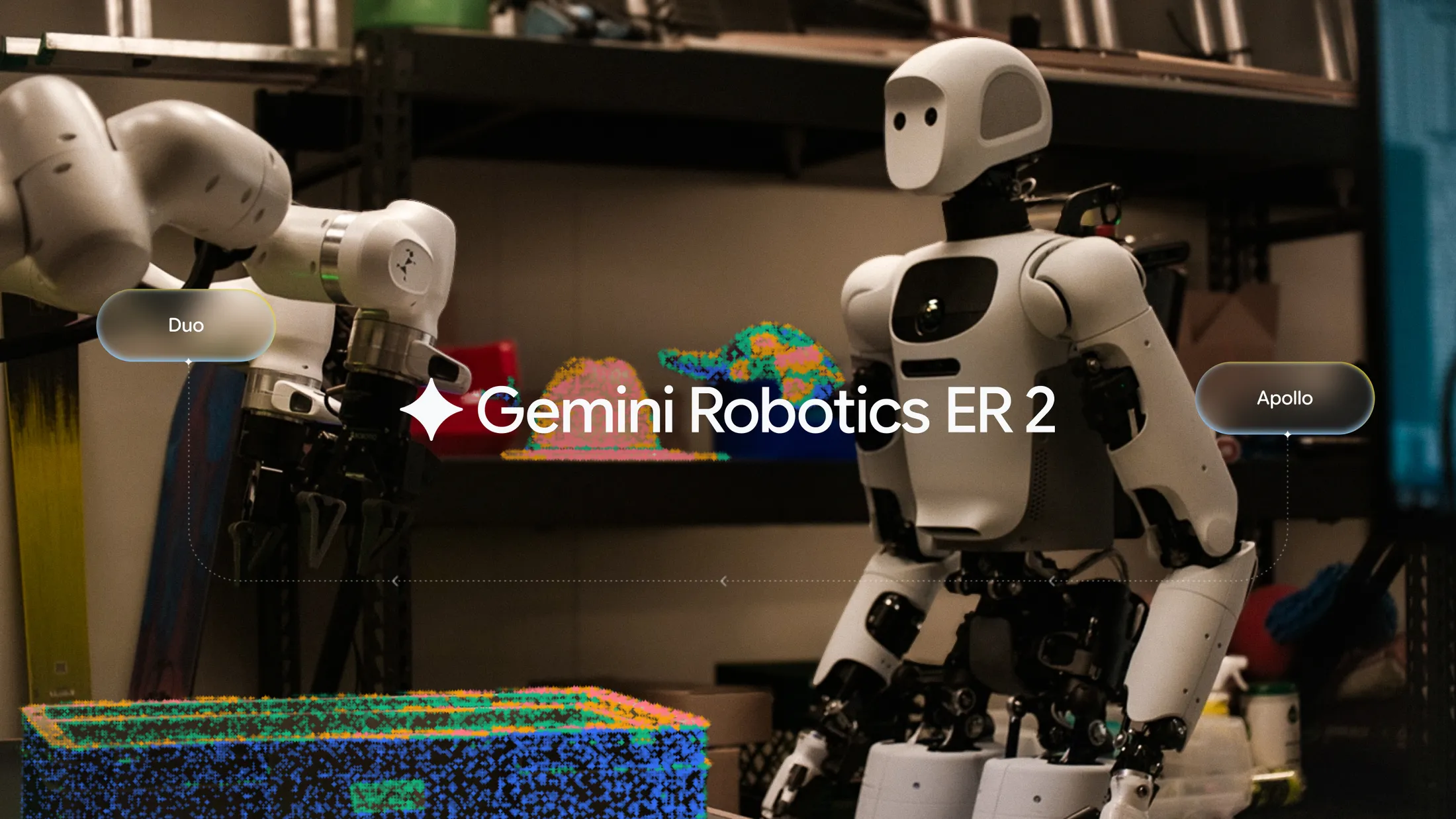
To solve this, Google Cloud has shipped Gemini Robotics Embodied Reasoning 2 (ER 2), a specialized frontier model available on the Gemini platform that transforms a robot into a physical agent. ER 2 serves as a universal intelligence layer across any embodiment—from stationary arms to wheeled rovers and complex humanoids. It combines advanced spatial and temporal video understanding with long-horizon planning and built-in safety guardrails.
Architecturally, ER 2 introduces three critical capabilities that redefine physical AI:
- Physical Task Verification and Self-Correction: ER 2 reasons over continuous video feeds to classify task progress into binary status, discrete categories, or continuous scores. It can pinpoint the exact video frame where a critical event occurs (e.g., when to stop pouring a liquid) with 91.3% accuracy and a 0.96-second mean absolute frame distance. This allows the robot to iterate on failed steps without restarting the entire workflow.
- Advanced Spatial Reasoning and Instrument Reading: The model can natively read and interpret values across more than ten instrument categories directly from visual input, including circular dials, sight glasses, digital displays, linear scales, rulers, and liquid thermometers.
- Agentic Tool Orchestration: Developers can declare low-level control interfaces—such as Vision-Language-Action (VLA) models, navigation APIs, or custom functions—as tools. ER 2 orchestrates these APIs from natural language commands, enabling multi-minute tasks involving hundreds of micro-decisions.
To orchestrate these capabilities in production, Google Cloud simultaneously advanced the Agent Development Kit (ADK) 2.0, an open-source framework that weaves deterministic code with adaptive AI reasoning through graph-based workflows.
Real-World Use Cases: Where This Moves the Needle in the Field
To understand the architectural impact of Gemini Robotics ER 2, we must examine how it resolves concrete operational friction across different industries.
1. High-Throughput Enterprise Workloads: Automated Quality Assurance in Manufacturing
- The Everyday Problem: In high-throughput manufacturing, traditional computer vision models are trained on static images of "perfect" and "defective" parts. When a novel defect appears, or a part is misaligned on the conveyor belt, the system throws an exception. The assembly line halts, tail-latency spikes, and human operators must manually clear the fault.
- How It Works in Practice: By deploying ER 2 via the Gemini Enterprise Agent Platform, the robotic inspection arm streams continuous multimodal video into the model. Instead of relying on static bounding boxes, ER 2 utilizes its deep spatio-temporal reasoning to understand the context of the misalignment. If a part is slightly skewed, ER 2 orchestrates the manipulator movement API to nudge the part into place, verifies the correction via video frame analysis, and proceeds with the inspection.
- The Tangible Impact: This isolates tail-latency and prevents cascading workflow failures under burst traffic. By enabling real-time situational awareness and self-correction, manufacturers drastically reduce mean time to recovery (MTTR) and improve overall equipment effectiveness (OEE).
2. Zero-Trust Governance & IAM: Hazardous Material Handling in Lab Automation
- The Everyday Problem: Robots operating in sensitive environments—such as pharmaceutical labs or nuclear facilities—require strict security boundaries. Historically, robotics control systems operated on flat, air-gapped networks. As these systems move to the cloud for advanced AI reasoning, exposing robot telemetry and control APIs creates a massive attack surface.
- How It Works in Practice: The architecture leverages Cloud Run as the serverless control plane hosting the ADK 2.0 agent. Each robot authenticates using a dedicated, least-privilege Google Cloud Service Account. The entire communication path between the factory floor and Vertex AI is encapsulated within a VPC Service Controls (VPC SC) perimeter. The ADK agent exposes specific, whitelisted tools (e.g.,
read_thermometer, seal_container) while blocking unauthorized lateral movement.
- The Tangible Impact: Organizations can enforce Zero-Trust governance and strict IAM boundaries without sacrificing the cognitive capabilities of frontier models. Security teams gain centralized audit logging in Cloud Logging, ensuring compliance in highly regulated industries.
3. Production FinOps & Unit Economics: Autonomous Fleet Management in Logistics
- The Everyday Problem: Running heavy, multimodal reasoning models for every micro-decision a robot makes (e.g., "move forward 10 centimeters") destroys unit economics and introduces unacceptable latency.
- How It Works in Practice: We implement a tiered reasoning architecture. Latency-sensitive, high-frequency tasks like Simultaneous Localization and Mapping (SLAM) and path planning are offloaded to the factory floor using Google Distributed Cloud. For high-level semantic routing, the system uses the highly optimized
gemini-2.5-flash model. Gemini Robotics ER 2 is invoked selectively only when the robot encounters a complex anomaly (e.g., a blocked aisle requiring a semantic understanding of the obstacle to determine if it can be safely moved).
- The Tangible Impact: This tiered approach optimizes cost-per-request and commit utilization on Google Cloud, ensuring that expensive compute cycles are reserved for tasks requiring deep spatio-temporal reasoning, thereby maintaining viable unit economics for large-scale fleet deployments.
Reference Architecture on Google Cloud
When designing a production-grade physical AI topology, separation of concerns is paramount. The architecture must decouple high-level cognitive reasoning (the "brain") from low-level kinematic control (the "spinal cord").
In this reference architecture, Google Cloud serves as the centralized intelligence and orchestration plane, while Google Distributed Cloud handles edge execution to prevent latency-induced physical collisions.
flowchart LR
    subgraph Edge["Factory Floor / Edge (Google Distributed Cloud)"]
        Robot["Physical Robot Fleet"]
        SLAM["Local SLAM & Path Planning"]
        VLA["Local VLA Models"]
        Robot <--> SLAM
        Robot <--> VLA
    end

    subgraph Gcp["Google Cloud Platform (VPC Service Controls Perimeter)"]
        subgraph Serverless["Orchestration Layer"]
            CR["Cloud Run (ADK 2.0 Agent Runtime)"]
        end

        subgraph Ai["Intelligence Layer (Vertex AI)"]
            ER2["Gemini Robotics ER 2"]
            Flash["Gemini 2.5 Flash"]
        end

        subgraph Data["Data & Telemetry"]
            BQ["BigQuery (Fleet Telemetry)"]
            GCS["Cloud Storage (Video Logs)"]
        end
    end

    %% Connections
    VLA <-->|gRPC / WebSockets| CR
    CR -->|Tool Calling / Video Stream| ER2
    CR -->|High-Throughput Routing| Flash
    CR -->|Audit & Metrics| BQ
    CR -->|Demonstration Videos| GCS

    classDef gcp fill:#e8f0fe,stroke:#4285f4,stroke-width:2px;
    classDef edge fill:#fce8e6,stroke:#ea4335,stroke-width:2px;
    class CR,ER2,Flash,BQ,GCS gcp;
    class Robot,SLAM,VLA edge;
Architectural Component Breakdown
- The Edge Layer (Google Distributed Cloud): Physical robots stream multimodal telemetry (video, audio, lidar) upward. To ensure safety, latency-sensitive local workloads like SLAM, collision avoidance, and immediate motor control loops remain on the factory floor.
- The Orchestration Layer (Cloud Run & ADK 2.0): Cloud Run acts as the highly scalable, serverless host for the ADK 2.0 agent. Cloud Run's concurrency model allows a single container instance to handle multiple multiplexed WebSocket streams from the robot fleet. The ADK 2.0 framework manages the graph workflow, maintaining conversational context, session state, and tool execution logic.
- The Intelligence Layer (Vertex AI): This is where the cognitive heavy lifting occurs. The ADK agent routes complex, long-horizon planning requests and video verification tasks to the
gemini-robotics-er-2 model. For simpler, high-frequency natural language interactions or log summarization, the agent routes to gemini-2.5-flash.
- The Data Layer (BigQuery & Cloud Storage): Continuous fleet telemetry is streamed into BigQuery for offline analysis and optimization. Demonstration videos and failed task recordings are stored in Cloud Storage. These assets are later used to curate and label datasets for training custom Vision-Language-Action (VLA) models via Google Kubernetes Engine (GKE) or Cluster Director.
Step-by-Step Implementation
To implement this architecture, we utilize the Agent Development Kit (ADK) 2.0 for Python. The ADK provides a structured, deterministic wrapper around the Gemini models, allowing us to define hardware APIs as callable tools.
Crucially, ADK 2.0 introduces graph workflows. By structuring the agent's thought process as a Directed Acyclic Graph (DAG), architects can enforce deterministic execution paths. For example, the agent must transition through a "Verify Safety Clearances" node before it is allowed to invoke the move_manipulator tool. This blends the adaptive reasoning of ER 2 with the strict safety guarantees required in physical engineering.
1. Defining the ADK 2.0 Agent and Tools
First, we define the low-level control interfaces as Python functions. The ADK will automatically convert these into OpenAPI-compliant tool schemas that Gemini Robotics ER 2 can understand and orchestrate.
import os
from google.adk import Agent
from google.adk.tools import tool

# 1. Define low-level hardware APIs as ADK Tools
@tool
def move_manipulator(target_x: float, target_y: float, target_z: float) -> str:
    """
    Commands the robotic arm to move to specific spatial coordinates.
    Use this tool after visually verifying the target location.
    """
    # In production, this issues a gRPC call to the edge VLA/kinematics engine
    return f"Manipulator moving to coordinates: ({target_x}, {target_y}, {target_z})"

@tool
def read_analog_dial(instrument_id: str) -> str:
    """
    Triggers a high-resolution capture of a specific analog dial.
    """
    # Instructs the edge camera to focus on the dial
    return f"Captured high-res image of dial {instrument_id} for ER 2 analysis."

# 2. Initialize the ADK Agent with Gemini Robotics ER 2
robotics_agent = Agent(
    name="factory_floor_supervisor",
    model="gemini-robotics-er-2", # Utilizing the specialized Embodied Reasoning model
    instruction="""
    You are the high-level cognitive brain for a robotic fleet.
    Your primary directive is to orchestrate physical tasks, verify success via video feeds,
    and self-correct if a step fails. Always read instruments before adjusting valves.
    Explain your approach while performing an action.
    """,
    tools=[move_manipulator, read_analog_dial],
)

# 3. Execute a reasoning loop (Simulated Input)
if __name__ == "__main__":
    # In production, this input would be a continuous multimodal stream
    response = robotics_agent.run(
        "The pressure dial on tank A looks high. Check the dial and adjust the release valve if it exceeds 50 PSI."
    )
    print(response.text)
2. Deploying to Cloud Run with Security Guardrails
Once the ADK agent is containerized, it must be deployed to Cloud Run with strict security configurations. We disable public ingress, enforce VPC egress, and assign a dedicated service account.
# Create a least-privilege service account for the robotics agent
gcloud iam service-accounts create robotics-agent-sa \
    --display-name="Robotics ADK Agent Service Account"

# Grant Vertex AI User role to access Gemini Robotics ER 2
gcloud projects add-iam-policy-binding my-enterprise-project \
    --member="serviceAccount:robotics-agent-sa@my-enterprise-project.iam.gserviceaccount.com" \
    --role="roles/aiplatform.user"

# Deploy the ADK Agent to Cloud Run
gcloud run deploy robotics-control-plane \
    --image=gcr.io/my-enterprise-project/robotics-adk-agent:v1 \
    --service-account=robotics-agent-sa@my-enterprise-project.iam.gserviceaccount.com \
    --ingress=internal-and-cloud-load-balancing \
    --vpc-egress=all-traffic \
    --network=projects/my-enterprise-project/global/networks/shared-vpc \
    --subnet=projects/my-enterprise-project/regions/us-central1/subnetworks/robotics-subnet \
    --concurrency=80 \
    --cpu=2 \
    --memory=4Gi \
    --region=us-central1
By setting --ingress=internal-and-cloud-load-balancing, we ensure the service is only accessible via an Internal HTTP(S) Load Balancer or API Gateway, protecting the control plane from the public internet. The --concurrency=80 flag leverages Cloud Run's ability to multiplex requests, significantly reducing cold starts and optimizing compute utilization for fleet telemetry streams.
Production Readiness: FinOps, Quotas & Security Guardrails
Transitioning physical AI from simulation (e.g., MuJoCo-Warp, NVIDIA Isaac Sim) to production requires rigorous attention to quotas, security perimeters, and unit economics.
Security and Quota Management
From a security perspective, the integration of physical robots with cloud-based AI necessitates a Zero-Trust architecture. The deployment must reside within a VPC Service Controls (VPC SC) perimeter. VPC SC mitigates data exfiltration risks by ensuring that the Cloud Run service, Vertex AI endpoints, and Cloud Storage buckets cannot be accessed from outside the defined trusted network, even if IAM credentials are compromised.
Regarding quotas, architects must monitor two critical boundaries:
- Cloud Run Concurrency and Instance Limits: While Cloud Run scales automatically, sudden bursts in fleet telemetry can trigger rapid scale-outs. Configuring
--max-instances prevents runaway compute costs during a fleet-wide anomaly, while --min-instances can be used to keep a baseline of agents warm to avoid latency spikes during critical physical operations.
- Vertex AI Quotas (TPM/RPM): Gemini models are constrained by Tokens Per Minute (TPM) and Requests Per Minute (RPM). Streaming continuous video from hundreds of robots will rapidly consume TPM quotas. Architects must implement exponential backoff in the ADK agent and request quota increases for
gemini-robotics-er-2 and gemini-2.5-flash in the target deployment region prior to fleet rollout.
📊 Production FinOps & TCO Simulation
To demonstrate the financial impact of architectural model selection, we utilize our deterministic FinOps engine to compare two deployment strategies for processing 100,000 robotics reasoning tasks per month.
Option A represents a brute-force approach using a heavy reasoning model (Gemini 2.5 Pro) for all tasks. Option B represents an optimized, high-throughput architecture utilizing Gemini 2.5 Flash for rapid, edge-optimized reasoning.
📊 Production FinOps & TCO Simulation: Monthly TCO: Fleet Telemetry & Video Reasoning (100k Tasks/Mo) (Based on the latest Google SKU information)
Production Workload Assumptions (us-central1 / asia-southeast1):
- 100,000 robotics reasoning tasks per month (e.g., video frame analysis, task verification)
- Option A uses Gemini 2.5 Pro for high-fidelity reasoning with 5s Cloud Run execution (2 vCPU, 4GB RAM)
- Option B uses Gemini 2.5 Flash for high-throughput edge-optimized reasoning with 2s Cloud Run execution (1 vCPU, 2GB RAM)
- Each task processes 2,000 input tokens (video/telemetry) and generates 500 output tokens (action plans)
| Architecture Option |
Google SKU Unit Price & Monthly Formula |
Estimated Monthly Cost |
| Option A: High-Fidelity Reasoning (Gemini 2.5 Pro) |
Cloud Run vCPU (5s/req, 2 vCPU): $2.4e-05/vCPU-second × 1,000,000 = $24.00
Cloud Run Memory (5s/req, 4 GiB): $2.5e-06/GiB-second × 2,000,000 = $5.00
Gemini 2.5 Pro Input (2k tokens/req): $1.25/1M input tokens × 200 = $250.00
Gemini 2.5 Pro Output (500 tokens/req): $10/1M output tokens × 50 = $500.00 |
$779.00 / mo |
| Option B: High-Throughput (Gemini 2.5 Flash) |
Cloud Run vCPU (2s/req, 1 vCPU): $2.4e-05/vCPU-second × 200,000 = $4.80
Cloud Run Memory (2s/req, 2 GiB): $2.5e-06/GiB-second × 400,000 = $1.00
Gemini 2.5 Flash Input (2k tokens/req): $0.15/1M input tokens × 200 = $30.00
Gemini 2.5 Flash Output (500 tokens/req): $0.6/1M output tokens × 50 = $30.00 |
$65.80 / mo |
| Net FinOps Impact (Monthly Savings) |
Based on the latest Google SKU information |
91.6% TCO Reduction ($713.20 / mo) |
Official Google Cloud SKU Pricing Sources (2026.09): cloud.google.com, cloud.google.com
The FinOps analysis reveals a critical architectural truth: the vast majority of the cost in Option A stems from the output tokens of the heavy reasoning model ($500.00/mo). Because robotics control requires continuous, high-frequency polling and action generation, relying solely on a heavy reasoning model is financially untenable at scale.
By utilizing Gemini 2.5 Flash for the bulk of the high-throughput routing and reserving Gemini Robotics ER 2 strictly for complex anomaly resolution, enterprises can achieve a 91.6% TCO reduction. This tiered intelligence architecture is the only viable path to scaling physical AI fleets without destroying unit economics.