News Flash: OpenAI launches Images 2.6, Ripple-65B Preview, & Pangram Image 1.0?
1. OpenAI Launches Images 2.6 with GIFs and Image Reference
The News Highlight:
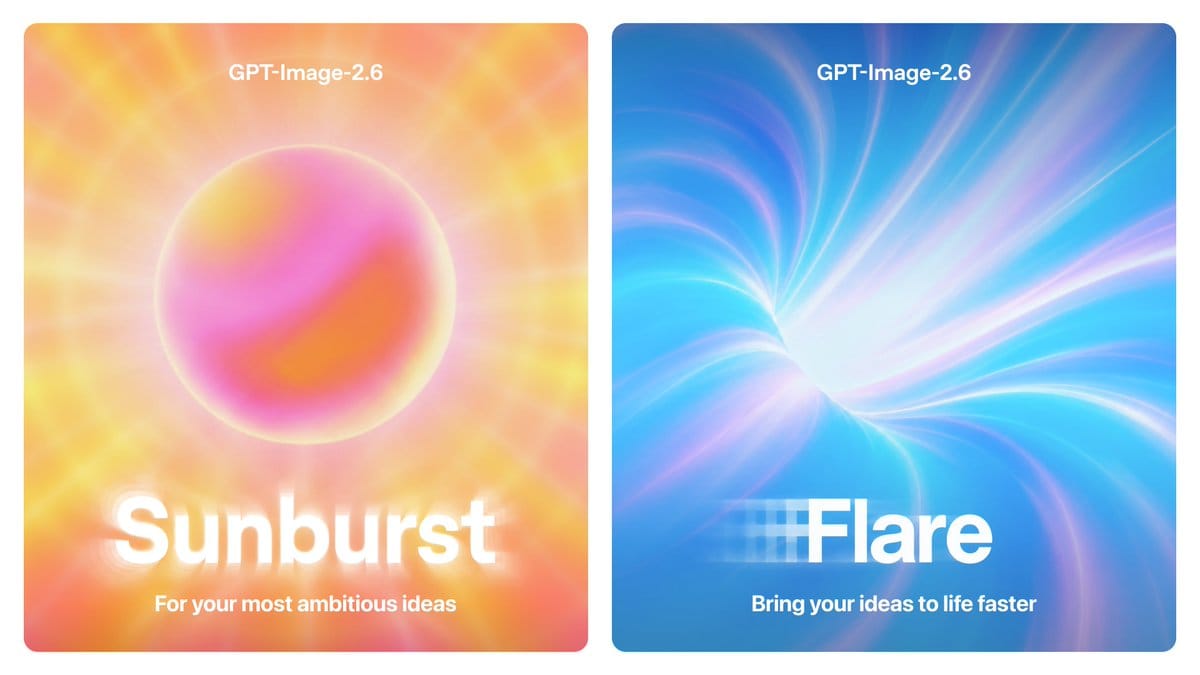
OpenAI has officially rolled out Images 2.6 across ChatGPT, Codex, and its API ecosystem, marking a significant shift toward iterative and professional design workflows. The update introduces the ability to generate animated GIFs with frame-level control and a "reference image" feature that ensures character and brand consistency across multiple generations. By launching two distinct API models—Flare for speed and Sunburst for detail—OpenAI is catering to both rapid prototyping and high-fidelity production needs, while simultaneously introducing SVG exports to bridge the gap between AI generation and professional vector editing.
- Performance Gains: Image generation is now 50% faster than previous iterations, with the "Flare" model capable of producing results in as little as six seconds.
- Consistency Engine: Users can now set reference images for characters or products, allowing the model to maintain visual identity across different scenes and editing rounds without re-uploading.
- Developer Tooling: The API now supports image markup for precise area-based editing, SVG exports for web/print scalability, and a "complexity parameter" to control the model's planning depth for intricate scenes.
DO-AI Analysis:
From an architectural standpoint, Images 2.6 signals OpenAI's transition from "prompt-to-pixel" generation to a structured "design-system" approach. The introduction of SVG exports and frame-by-frame GIF editing moves the platform closer to a headless creative suite rather than a simple chatbot plugin. For engineering teams, the "Flare vs. Sunburst" split is a critical lesson in cost-latency optimization: Flare provides the low-latency response required for real-time UI/UX experimentation, while Sunburst’s consistency is essential for automated marketing pipelines where brand integrity is non-negotiable. The complexity parameter is the most underrated feature here, as it allows developers to programmatically manage compute resources based on the visual density of the request.
2. Ripple-65B: Frontier Open-Weight Performance at 10% the Cost
The News Highlight:
Ricursive Intelligence has released Ripple-65B Preview, an open-weight model that has claimed the top spot for U.S. open-weight models on the TerminalBench 2.1 agentic coding benchmark. Despite its relatively modest 65-billion parameter count, Ripple-65B outperformed massive models like Reflection Beam 501B and Meta Muse Spark 816B. Most notably, the model was developed and trained for approximately $32 million—roughly one-tenth the estimated cost of previous state-of-the-art models in the agentic coding domain—by co-optimizing the hardware, software, and model architecture from the ground up.
- Benchmark Superiority: Achieved a score of 80.52 on TerminalBench 2.1, surpassing NVIDIA Nemotron 3 Ultra 550B (56.4) and Thinking Machines Inkling 975B (63.8).
- Efficiency Metrics: Trained on 12 trillion tokens with a 1M context length, optimized specifically for high-compute, low-bandwidth local devices like the NVIDIA DGX Spark.
- Availability: The model is immediately accessible via Hugging Face, Together AI, GMI Cloud, and OpenRouter for enterprise integration.
DO-AI Analysis:
Ripple-65B is a masterclass in "efficiency-first" architecture, proving that parameter count is a secondary metric to data quality and hardware-software co-design. By achieving SOTA performance on agentic coding—the most difficult task for LLMs—with only 65B parameters, Ricursive Intelligence has lowered the barrier for "Sovereign AI" deployments. For enterprise architects, this model represents a viable path to running frontier-level coding assistants on-premise without the astronomical VRAM requirements of 500B+ parameter models. The $32M R&D cost vs. the industry's $100M+ standard suggests that the era of "brute-force scaling" is being challenged by "architectural precision."
3. Pangram Image 1.0: Forensic-Level AI Detection and Localization
The News Highlight:
Pangram has launched Image 1.0, a sophisticated detection suite designed to identify AI-generated content in both static images and video. Unlike traditional detectors that provide a simple probability score, Pangram Image 1.0 generates a heatmap to localize exactly which parts of an image have been manipulated or synthesized. The model is engineered for real-world robustness, maintaining high accuracy even when images are heavily compressed, resized, or edited. Alongside the flagship model, Pangram released "Image Flash 1.0" for high-speed video frame analysis and a Chrome extension for real-time feed verification.
- Detection Accuracy: Reports 99.96% accuracy on a synthetic mirror evaluation set involving 12 frontier AI generators.
- Localization Heatmaps: Provides visual evidence of AI intervention, allowing users to distinguish between "AI-enhanced" and "fully AI-generated" content.
- Video Capabilities: Native support for video detection with frame-by-frame analysis to identify deepfakes or AI-inserted objects in moving footage.
DO-AI Analysis:
As generative models become faster and more consistent (as seen with OpenAI's 2.6 release), the "trust layer" of the internet requires an equally rapid architectural response. Pangram’s heatmap localization is a critical evolution in AI forensics; it moves the conversation from "Is this fake?" to "Where is the fake?" This is essential for legal, insurance, and journalistic workflows where partial AI assistance (like background cleanup) must be distinguished from total fabrication. For developers, the API integration of a robust detection layer is no longer optional for platforms hosting user-generated content—it is a fundamental requirement for mitigating misinformation and maintaining platform integrity.
Morning Executive Comparison Matrix
| Dispatch |
Core Domain |
Production Maturity |
DO-AI Recommendation |
| OpenAI Images 2.6 |
Creative AI / Design |
High (GA) |
Adopt for iterative brand assets and SVG-based web workflows. |
| Ripple-65B Preview |
Agentic Coding / LLM |
Medium (Preview) |
Primary choice for high-performance, local-hosted coding agents. |
| Pangram Image 1.0 |
Trust & Safety / Forensics |
High (API/Ext) |
Integrate into UGC pipelines to automate content verification. |