News Flash: Mistral Large 4, Nano Banana 2.1, & Sharing AI progress?
1. Mistral Large 4: The 1-Trillion Parameter "Le Chonk" Challenges Global Frontiers
The News Highlight:
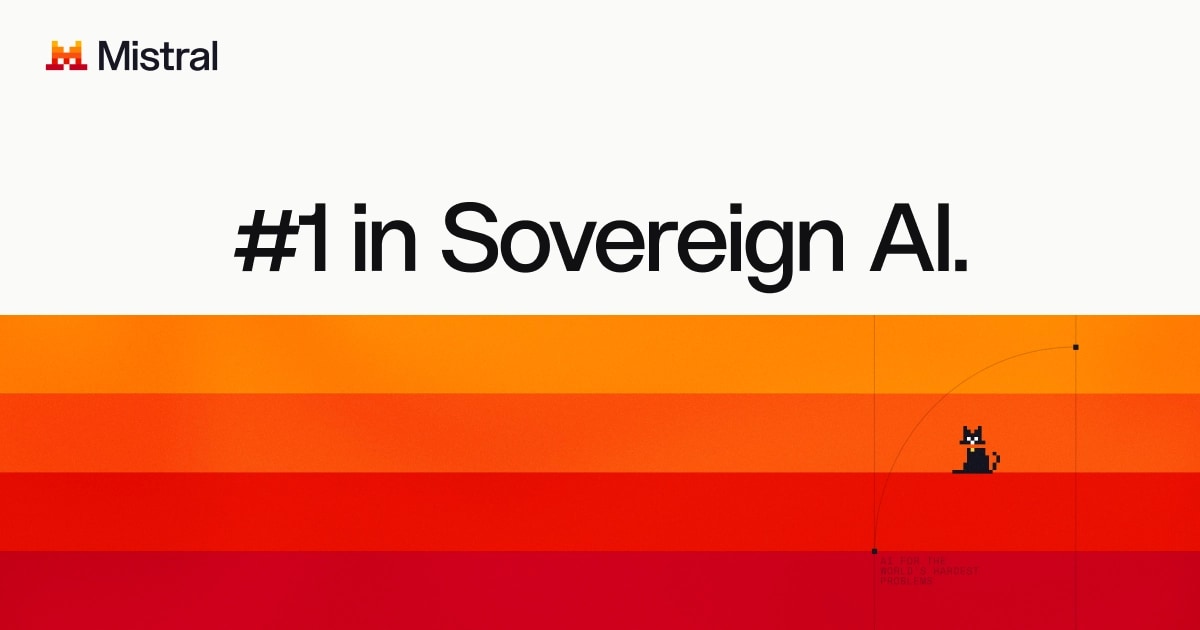
Mistral AI has announced the public preview of Mistral Large 4 (ML4), colloquially dubbed "Le Chonk," marking a significant milestone for European AI sovereignty. This natively multimodal model is designed to compete directly with the world's most advanced closed-source systems, offering frontier-level performance in coding, agentic workflows, and visual grounding. By positioning ML4 as an open-weight alternative, Mistral aims to provide enterprises with a high-performance model that can be deployed within sovereign infrastructures, reducing dependency on non-European providers. The model is currently available via API, with a full weights release scheduled for the end of October 2026.
- Architectural Scale: Features 1 trillion total parameters with a highly efficient 52 billion active parameters, indicating a sophisticated Mixture-of-Experts (MoE) architecture.
- Training Infrastructure: Developed from scratch using 3,800 NVIDIA Grace Blackwell GPUs hosted within Mistral’s dedicated European data centers.
- Performance Benchmarks: Demonstrates state-of-the-art results in cybersecurity, finance, and legal domains, specifically outperforming existing open-weight models in visual grounding and terminal-based coding tasks (Terminal Bench 4.0).
- Security & Red-Teaming: Currently undergoing rigorous testing with state authorities and cybersecurity leaders to refine reduced-moderation versions for specialized defensive cyber capabilities.
DO-AI Analysis:
From an architectural standpoint, ML4 represents the pinnacle of Mixture-of-Experts (MoE) scaling. By maintaining only 5.2% of its total parameters as "active" during inference, Mistral is solving the primary bottleneck of trillion-parameter models: the prohibitive cost of compute per token. For engineering teams, the "Le Chonk" release signals that open-weight models have finally closed the gap with frontier closed-source APIs in complex reasoning and multimodal understanding. The decision to train on Grace Blackwell infrastructure in Europe is a strategic masterstroke for data residency compliance, allowing firms in highly regulated sectors to leverage top-tier intelligence without compromising architectural sovereignty.
2. Nano Banana 2.1: Google’s Gemini 3 Evolution Scales Multimodal Context
The News Highlight:
Google DeepMind has unveiled Nano Banana 2.1, the latest iteration within the Gemini 3 series, specifically optimized for high-throughput multimodal tasks. Built upon the Gemini 3.6 Flash architecture, this model is designed to bridge the gap between lightweight efficiency and massive context handling. Nano Banana 2.1 supports both text and image inputs while generating high-fidelity multimodal outputs, making it a versatile engine for Google’s broader ecosystem. The release emphasizes seamless integration across developer tools like Google Flow and Google Stitch, aiming to streamline the creation of intelligent, context-aware agents.
- Context Window: Supports an expansive 1 million token context window, allowing for the processing of massive datasets or long-form video content in a single prompt.
- Multimodal I/O: Capable of native image generation and editing alongside complex text reasoning, moving beyond simple captioning to creative synthesis.
- Ecosystem Integration: Immediately available across Google AI Studio, Google Search AI Mode, Google Ads, and the new Google Flow automation suite.
- Efficiency Profile: Derived from the "Flash" lineage, prioritizing low-latency responses without sacrificing the reasoning depth required for enterprise-grade agentic workflows.
DO-AI Analysis:
Nano Banana 2.1 highlights a shift in Google’s strategy toward "omni-capable" small-to-medium models. The 1-million token context window on a Flash-class model suggests significant optimizations in KV-cache management and attention mechanisms. For developers, the real value lies in the integration with "Google Flow" and "Stitch," which points toward a future where LLMs are not just chat interfaces but the connective tissue of automated DevOps and marketing pipelines. The trade-off here is the reliance on the Google Cloud vertex ecosystem, but for teams already embedded there, the latency-to-context ratio of Nano Banana 2.1 is currently unmatched for real-time multimodal applications.
3. OpenAI Open-Sources Mathematical Reasoning Protocols and Lean Formalizations
The News Highlight:
OpenAI has released a comprehensive dataset and a set of protocols derived from its internal frontier models' progress in advanced mathematics. Rather than just releasing model weights, OpenAI is sharing the "reasoning traces" and formalizations of mathematical proofs in Lean, a functional programming language and theorem prover. This move is intended to standardize how AI-generated mathematical breakthroughs are cited, verified, and integrated into the scientific community. The release includes a GitHub repository containing formal proofs, paper revision protocols, and detailed statistics on the compute resources required to solve complex mathematical conjectures.
- Formal Verification: Includes a library of proofs formalized in Lean, moving AI outputs from probabilistic "guesses" to mathematically verifiable certainties.
- Transparency Metrics: Provides 10 detailed summaries of model reasoning paths and estimations of compute spent, measured in "Pro usage" units on ChatGPT.
- Scientific Protocol: Establishes new standards for how AI-assisted research should be cited and how model-generated revisions to scientific papers should be documented.
- Problem Statistics: Shares data on the success rates and attempted methodologies for a broad range of frontier-level mathematical problems.
DO-AI Analysis:
This release is a pivot toward "Verifiable AI." By utilizing Lean formalizations, OpenAI is addressing the "hallucination" problem at its root—logical inconsistency. For software architects and engineers, this signifies that the next generation of coding assistants will likely move toward formal methods, where the AI doesn't just write code but provides a mathematical proof that the code meets its specifications. The publication of reasoning traces is a high-signal move for the industry, providing a blueprint for how we might eventually audit the "thought processes" of black-box models in high-stakes engineering environments.
Morning Executive Comparison Matrix
| Dispatch |
Core Domain |
Production Maturity |
DO-AI Recommendation |
| Mistral Large 4 |
Frontier LLM / Multimodal |
Public Preview (Weights Soon) |
Adopt for sovereign enterprise workloads requiring top-tier reasoning. |
| Nano Banana 2.1 |
Multimodal / Long-Context |
Production Ready (Google Cloud) |
Use for high-throughput, long-context agents within the Google ecosystem. |
| OpenAI Math Progress |
Formal Verification / R&D |
Research / Protocol Release |
Integrate Lean formalization into critical logic-path testing workflows. |