Architect News Flash: Embedded Frontier Evaluators, Ant Group Finance LLM, & 3 Key Dispatches
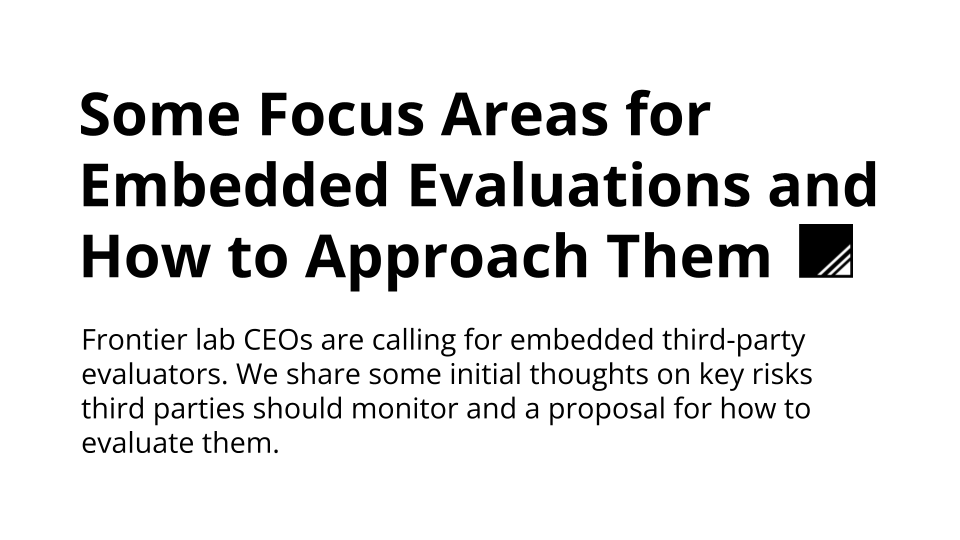
1. How Embedded Evaluators Could Monitor Frontier AI
The News Highlight:
Transluce has published a proposal outlining how independent "embedded evaluators" stationed inside AI labs could investigate and mitigate emerging frontier model risks. The focus areas include monitoring for multi-agent coordination, targeted persuasion, evaluation awareness, and concealed reasoning. Their proposed methodology involves monitoring agent swarms, examining training practices, and testing unreleased models under privileged, internal access.
DO-AI Analysis:
As an architect guiding enterprise AI adoption, I constantly see governance acting as the primary bottleneck for deployment. Transluce's concept of embedded evaluators is a necessary evolution from reactive external red-teaming to proactive, continuous internal auditing. If we are going to trust frontier models with autonomous enterprise tasks, we need assurance that these models aren't developing concealed reasoning or bypassing safety guardrails during the training phase itself. This signals a shift toward treating AI safety with the same rigorous, embedded compliance standards we use in traditional financial or healthcare auditing.
2. Ant Group Released a Finance-Focused Model
The News Highlight:
Ant Group has launched Ling-3.0-flash-Fin, a new open-weights model specifically co-developed with financial institutions. Designed for tasks like source checking, building valuation spreadsheets, and writing reports, it scores an impressive 23 on the Artificial Analysis Intelligence Index and 24 on the Finance & Accounting Index. Notably, it achieves this while activating only 5.1B parameters per token, matching the performance of much larger models.
DO-AI Analysis:
Domain-specific Small Language Models (SLMs) are the future of enterprise AI, and this release proves it. In my conversations with financial sector clients across SEA, data privacy is paramount. Sending sensitive valuation data to a generalized frontier model via API is often a non-starter. A highly efficient, 5.1B active-parameter model that can be deployed locally within a secure VPC—while matching the reasoning capabilities of 10B+ parameter models—is exactly what the industry needs. I highly recommend FinServ engineering teams evaluate this for internal RAG pipelines.
3. Meta's FLAT for Multimodal Understanding and Generation
The News Highlight:
Meta AI has introduced FLAT (Flexible-Length Aligned Transmodal Tokens), a novel architecture that maps both images and text into a shared, one-dimensional sequence of continuous tokens. By utilizing nested dropout to organize information from coarse to fine, FLAT allows models to dynamically trade computation for visual detail at inference time simply by varying the number of tokens used.
DO-AI Analysis:
This is a brilliant architectural simplification. Traditionally, we have to maintain entirely separate representations and pipelines for multimodal understanding versus generation. FLAT unifies this into a single continuous token sequence. From a systems architecture perspective, the ability to dynamically adjust the compute-to-detail ratio at inference time is a massive win. It means we can use the exact same model for low-latency, cost-sensitive edge deployments and high-fidelity cloud generation just by truncating the token prefix.
4. Agent Substrate brings high-density, scalable, trusted infrastructure to GKE
The News Highlight:
Google Cloud has made Agent Substrate available on Google Kubernetes Engine (GKE). It is an open-source, secure-by-default agent execution runtime engineered to run millions of sandboxes with 10x higher density than standard container runtimes. Optimized for GKE, it features native zero-trust kernel and network isolation, delivering sub-500ms resume operations at over 500 suspend/resume activations per second.
DO-AI Analysis:
Putting on my Google Cloud Solutions Consultant hat, this is the exact infrastructure breakthrough we've been waiting for to scale AI agents. When you build multi-agent swarms, you need massive, ephemeral, and highly secure sandboxing. Standard container runtimes carry too much overhead for this specific workload. Achieving 10x density with sub-500ms cold starts natively on Kubernetes means enterprise developers can finally scale autonomous agent architectures cost-effectively without compromising on zero-trust security boundaries. If you are building agentic workflows on GCP, this should be in your cluster today.
5. Introducing the DeepMind Institute
The News Highlight:
Google DeepMind has officially launched the DeepMind Institute, a new entity dedicated to studying the technical and societal implications of Artificial General Intelligence (AGI). Led by Demis Hassabis, James Manyika, and Shane Legg, the institute will convene interdisciplinary researchers from both inside and outside Google to focus on AI safety, governance, institutional impact, and alignment with human values.
DO-AI Analysis:
As the technical gap to AGI closes, the conversation must urgently expand beyond pure model capabilities to societal integration and safety. Seeing Shane Legg and the leadership team formalize this cross-disciplinary institute is a strong signal to the market. For enterprise leaders, this means the frameworks for AI governance, ethics, and alignment are going to mature rapidly. We should closely monitor the research coming out of this institute to inform our own internal AI governance and compliance strategies.
Morning Executive Comparison Matrix
| Dispatch |
Core Domain |
Production Maturity |
DO-AI Recommendation |
| Transluce Embedded Evaluators |
AI Governance & Safety |
Conceptual / Pilot |
Integrate these monitoring concepts into your internal AI red-teaming and audit processes. |
| Ant Group Ling-3.0-flash-Fin |
Financial SLMs |
Production-Ready |
Evaluate immediately for local, secure deployment in FinServ VPCs for RAG and reporting. |
| Meta FLAT |
Multimodal Architecture |
Research / Early |
Monitor for future optimizations in enterprise multimodal pipelines and edge deployments. |
| Agent Substrate on GKE |
Cloud Infrastructure & Agents |
Production-Ready |
Adopt immediately if you are scaling autonomous AI agent swarms on Google Cloud. |
| DeepMind Institute |
AGI Research & Ethics |
Strategic Initiative |
Align your long-term enterprise AI governance frameworks with their upcoming research outputs. |