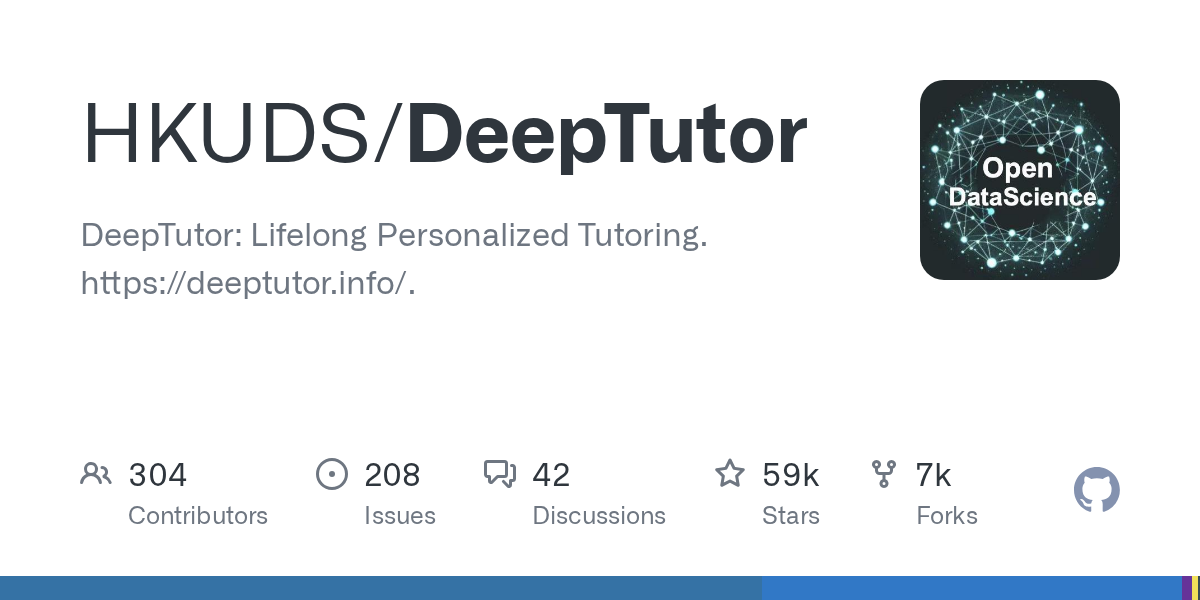
Inside HKUDS/DeepTutor: Architecture & Production Teardown — How Does It Work in Production?
TL;DR: HKUDS/DeepTutor is a massively popular (58.9k+ stars) open-source multi-agent system designed for lifelong, stateful personalized learning and deep research. By combining advanced parsing engines (Apache Tika, MinerU), graph-based retrieval (LightRAG), and Model Context Protocol (MCP) servers, it provides a production-ready blueprint for building persistent, context-aware AI workspaces that operate far beyond simple stateless chat interfaces.
What Is Inside HKUDS/DeepTutor: Architecture & Production Teardown & Why Is It Blowing Up?
In the current landscape of generative AI, the vast majority of applications are thin wrappers around stateless API endpoints. They suffer from context amnesia, struggle with complex document ingestion, and fail to maintain long-term state. HKUDS/DeepTutor fundamentally rejects this architecture. Originating as a research initiative (arXiv:2604.26962) and exploding to over 58,900 stars on GitHub, DeepTutor is a comprehensive, multi-agent system engineered for "Lifelong Personalized Tutoring" and deep, interactive research.
When we evaluate the repository at HKUDS/DeepTutor#readme, it becomes immediately clear why this project is trending. It is not just a prompt template; it is a full-stack orchestration engine. DeepTutor solves the "persistent context" problem by implementing self-syncing knowledge bases, isolated execution runtimes, and a highly modular plugin architecture. It supports everything from immersive EPUB/PDF reading with cited, page-by-page grounding, to native integration with external tools like MarginNote 4, Anki, and Kiwix archives.
For systems engineers, the appeal lies in its unopinionated flexibility regarding infrastructure. It ships with an Antigravity CLI, supports Python 3.14, and utilizes a task model for background work, ensuring that heavy embedding and retrieval jobs do not block the main event loop.
Real-World Field Use Cases: Where This Moves the Needle in the Field
While branded as a "tutoring" system, the underlying architecture of DeepTutor is a masterclass in stateful RAG (Retrieval-Augmented Generation) and multi-agent orchestration. Here is how engineering teams are adapting these primitives for enterprise workloads:
1. Developer Platform Integration: Embedding into CI/CD and Microservice Pipelines
- The Everyday Problem: Internal developer portals and documentation repositories are often fragmented. Engineers waste hours searching across Jira, Confluence, GitHub, and Slack to understand why a specific microservice was built a certain way.
- How It Works in Practice: Teams can deploy DeepTutor's core ingestion engines (LiteParse and Apache Tika) to continuously index internal GitHub repositories and Markdown documentation. By utilizing DeepTutor's
exec tool and MCP (Model Context Protocol) servers, the system can be embedded directly into CI/CD pipelines. When a build fails, an internal agent can query the DeepTutor knowledge base to retrieve historical PRs and architectural decisions related to the failing module.
- The Tangible Impact: Reduces mean time to resolution (MTTR) for internal debugging by providing engineers with cited, grounded answers drawn directly from the organization's historical codebase, rather than generic LLM hallucinations.
2. Concurrency & Memory Footprint: Evaluating P99 Latency Under Load
- The Everyday Problem: Scaling multi-agent systems often leads to catastrophic memory leaks and unacceptable P99 latencies, especially when multiple agents are concurrently parsing large PDFs or executing code in sandboxed environments.
- How It Works in Practice: DeepTutor's architecture introduces "faster isolated runtimes" and a dedicated "task model for background work" (introduced in v1.6.1). Engineers can deploy the system using the provided
docker-compose.ghcr.yml to isolate the web frontend, the agent router (OrcaRouter), and the embedding workers. By bounding tutoring memory and utilizing resumable embedding checkpoints (v1.7.0), the system prevents out-of-memory (OOM) crashes during massive document ingestion.
- The Tangible Impact: Predictable resource utilization. Teams can horizontally scale the background task workers independently of the chat interface, ensuring that the user-facing API maintains sub-second latency even while the system is indexing gigabytes of Kiwix archives in the background.
3. Build-vs-Buy Adoption Verdict: Operational Trade-offs vs. Managed Cloud
- The Everyday Problem: CTOs and platform architects constantly weigh the cost of building a custom RAG pipeline against buying managed services (like Google Cloud Vertex AI or AWS Bedrock Knowledge Bases). Managed services are easy but offer limited control over the parsing and retrieval algorithms.
- How It Works in Practice: DeepTutor serves as the ultimate "Build" blueprint. It allows teams to swap out search providers dynamically (Doubao, Bocha, Zhipu, Firecrawl, Qianfan, Aliyun IQS) and utilize native LightRAG role models. If a team needs strict data sovereignty, they can run DeepTutor entirely on-premise, leveraging local models via Ollama or vLLM, and utilizing the self-hosted
PageIndex OSS for reasoning retrieval.
- The Tangible Impact: Complete control over the data plane and zero vendor lock-in. While the operational overhead of managing the container orchestration falls on the internal DevOps team, the organization avoids exorbitant token-based pricing for document ingestion and retains the ability to fine-tune the retrieval heuristics.
Under the Hood: Architecture & Design Choices
Inspecting the commit history and the extensive HKUDS/DeepTutor/releases log reveals a highly decoupled, service-oriented architecture. The system is designed to handle asynchronous tasks, complex document parsing, and multi-model routing without blocking the user interface.
Here is a structural mapping of the DeepTutor execution pipeline:
flowchart LR
    subgraph IngestionLayer["Ingestion Layer"]
        A[Raw Documents: PDF/EPUB/Web] --> B{Parser Router}
        B -->|Legacy/Enterprise| C[Apache Tika]
        B -->|Complex Layouts| D[MinerU]
        B -->|High Speed| E[LiteParse]
    end

    subgraph StorageRetrieval["Storage & Retrieval"]
        C & D & E --> F[Embedding Engine]
        F --> G[(PageIndex OSS)]
        F --> H[(LightRAG Graph)]
        G & H --> I[Self-Syncing Knowledge Base]
    end

    subgraph AgentOrchestration["Agent Orchestration"]
        J[User Query / CLI] --> K[OrcaRouter / CodeBuddy]
        I --> K
        K --> L{MCP Servers}
        L <--> M[External Tools: Search/Exec]
        L <--> N[LLM Providers: Gemini/OpenAI/Local]
    end

    K --> O[Isolated Runtimes / Task Model]
    O --> J
1. The Ingestion and Parsing Pipeline
DeepTutor does not rely on a single, monolithic parsing library. Recognizing that document structures vary wildly, the architecture implements a multi-engine approach. For standard, high-speed text extraction, it utilizes a custom LiteParse engine. For complex, multi-format documents (like academic papers with dense mathematical formulas), it leverages MinerU. For legacy enterprise formats, it falls back to the battle-tested Apache Tika. This redundancy ensures "resilient document parsing" (v1.6.13) and prevents the system from quietly failing when encountering malformed PDFs.
2. Retrieval-Augmented Generation (RAG) Evolution
Standard vector databases often fail in educational or research contexts because they lose the structural and semantic relationships between entities. DeepTutor addresses this by integrating LightRAG natively. LightRAG constructs a graph-based representation of the ingested knowledge, allowing the system to perform "reasoning retrieval." Furthermore, the introduction of PageIndex OSS (v1.5.15) allows users to host their own indexing service, which records and enforces exactly what built the index, ensuring cryptographic-level traceability of the knowledge base.
3. Agent Routing and The Model Context Protocol (MCP)
At the core of DeepTutor's execution loop are CodeBuddy and OrcaRouter. These components act as the traffic cops for incoming queries, determining which agent harness is best suited for the task. Crucially, DeepTutor has adopted the Model Context Protocol (MCP). MCP servers act as standardized bridges between the core LLM and external tools. In DeepTutor, these MCP servers are designed to reconnect automatically on credential changes (v1.5.12), ensuring high availability.
4. Architectural Parallels with Enterprise Agent Frameworks
When evaluating DeepTutor's multi-agent orchestration, it is highly instructive to compare it against enterprise-grade frameworks like the Google Agent Development Kit (ADK). While DeepTutor provides a highly specialized, out-of-the-box application layer for tutoring and research, frameworks like ADK focus on the underlying developer primitives.
For instance, ADK 2.0 introduces "Graph Workflows" to weave deterministic code with adaptive AI reasoning, ensuring explicit execution paths. DeepTutor achieves a similar deterministic outcome through its "Mastery Path modes" that strictly gate tool access based on the user's progress. Furthermore, where ADK utilizes the A2A (Agent-to-Agent) protocol for collaborative workflows across different languages (Python, Go, Java), DeepTutor relies on its internal task model and MCP servers to delegate background work (like compiling books or syncing web sources) away from the primary conversational agent. Engineering teams looking to extend DeepTutor into broader enterprise ecosystems could theoretically wrap DeepTutor's isolated runtimes within an ADK Graph Workflow to standardize observability and deployment.
Hands-On Quickstart & Code Walkthrough
DeepTutor is designed to be deployed via Docker for production stability, but it also ships with a powerful CLI for local development and diagnostics. Based on the repository structure (docker-compose.yml, pyproject.toml, deeptutor_cli), here is how an engineer would bootstrap the environment.
1. Environment Configuration
First, clone the repository and set up the environment variables. DeepTutor requires explicit configuration for its various providers and database connections.
git clone https://github.com/HKUDS/DeepTutor.git
cd DeepTutor

# Copy the example environment file
cp .env.example .env

# Edit .env to include your LLM provider keys and search API keys
# e.g., OPENAI_API_KEY, FIRECRAWL_API_KEY
2. Containerized Deployment
For a reliable setup, especially when dealing with the complex dependencies of Apache Tika and MinerU, Docker is the recommended path. The repository includes multiple compose files (docker-compose.yml, docker-compose.dev.yml, docker-compose.ghcr.yml).
# Pull the latest images and start the stack in detached mode
docker compose up -d

# Check the logs to ensure the OrcaRouter and MCP servers initialized
docker compose logs -f
3. The Antigravity CLI
DeepTutor ships with a native CLI tool, referred to in the releases as the Antigravity CLI. This is crucial for system administration and debugging. If you are running the system locally (e.g., via uv or standard pip after installing from pyproject.toml), you can utilize the CLI directly.
# Install the CLI package locally (assuming a virtual environment)
pip install -e packages/deeptutor-cli

# Run the diagnostic tool introduced in v1.5.17
deeptutor doctor

# Example Output:
# [OK] Python Version: 3.14.0
# [OK] Database Connection: Established
# [OK] MCP Servers: 3/3 Connected
# [WARN] Apache Tika: Unreachable at localhost:9998
4. Interacting with the Agent API
While DeepTutor has a rich web interface (deeptutor_web), engineers will often want to interact with the agent programmatically. Based on the architecture, you can trigger background tasks—like generating a compiled "Book" from a knowledge base—via the API.
# Conceptual example of triggering a DeepTutor background task
import requests

DEEPTUTOR_API = "http://localhost:8000/api/v1"
HEADERS = {"Authorization": "Bearer YOUR_VENDOR_KEY"}

# Initiate a workspace sync (v1.6.11 feature)
payload = {
    "workspace_id": "ws_alpha_001",
    "action": "sync_knowledge_base",
    "engine": "liteparse",
    "use_lightrag": True
}

response = requests.post(f"{DEEPTUTOR_API}/workspaces/sync", json=payload, headers=HEADERS)

if response.status_code == 202:
    task_id = response.json().get("task_id")
    print(f"Background sync initiated. Task ID: {task_id}")
    # The task model handles this asynchronously, preventing HTTP timeouts
My Honest Verdict: Where It Fits in Your Stack (Pros & Trade-offs)
After a thorough architectural review of HKUDS/DeepTutor, it is evident that this is not a toy project. It is a heavy-duty, stateful AI orchestration engine. However, like all complex systems, it comes with distinct engineering trade-offs.
The Pros: Where DeepTutor Excels
- Uncompromising Stateful Architecture: The integration of LightRAG, PageIndex OSS, and self-syncing knowledge bases means DeepTutor actually "remembers" and structures information. It solves the context-window limitation not just by stuffing more tokens, but by intelligently routing graph-based retrieval.
- Robust Ingestion Redundancy: By supporting Apache Tika, MinerU, and LiteParse simultaneously, the system acknowledges the harsh reality of unstructured data. It does not assume clean Markdown; it is built to handle messy, real-world PDFs and EPUBs.
- Extensibility via MCP: The use of the Model Context Protocol ensures that adding new tools or capabilities does not require rewriting the core agent logic. The system is highly modular, allowing teams to plug in custom internal APIs seamlessly.
The Trade-offs: What You Need to Watch Out For
- Operational Complexity: DeepTutor is a distributed system. You are not just running a Python script; you are managing isolated runtimes, multiple parsing engines, graph databases, and MCP servers. The infrastructure footprint is significant. Teams without dedicated DevOps resources will find the
docker-compose stack daunting to monitor and scale in production.
- Dependency Matrix: Supporting everything from MarginNote 4 integrations to Kiwix archives and six different web search providers (Doubao, Firecrawl, etc.) creates a massive dependency surface area. Keeping all these integrations stable as upstream APIs change requires constant vigilance, as evidenced by the frequent "fix releases" in their changelog.
- Overkill for Simple Use Cases: If your goal is simply to provide a chat interface over a static set of company policies, DeepTutor is massive overkill. A simple LangChain or LlamaIndex script deployed on AWS Lambda would suffice. DeepTutor is designed for lifelong, evolving knowledge workspaces.
Final Verdict
HKUDS/DeepTutor is a phenomenal open-source achievement that pushes the boundaries of what multi-agent systems can accomplish in stateful environments. For organizations building internal research portals, complex educational platforms, or deep-dive developer documentation systems, DeepTutor provides a production-ready, batteries-included foundation.
However, engineering leaders must approach it with eyes wide open regarding its operational weight. It is best deployed by teams who understand container orchestration and are prepared to manage the lifecycle of graph databases and asynchronous task workers. If you have the infrastructure maturity to support it, DeepTutor offers a level of persistent, grounded AI interaction that managed cloud wrappers simply cannot match.