Inside eternity4719/HowToLiveBetter: Architecture & Production Teardown — How Does It Work in Production?
TL;DR: eternity4719/HowToLiveBetter is a highly structured, evidence-based markdown repository containing 677 life optimization directives, designed not just for human reading but as a deterministic knowledge base for AI agents. By integrating this repository's strict schema with frameworks like the Google Agent Development Kit (ADK), engineering teams can build robust, locally-hosted RAG pipelines and AI skills that deliver verifiable, cost-benefit-analyzed life and legal advice in production environments.
What Is Inside eternity4719/HowToLiveBetter: Architecture & Production Teardown & Why Is It Blowing Up?
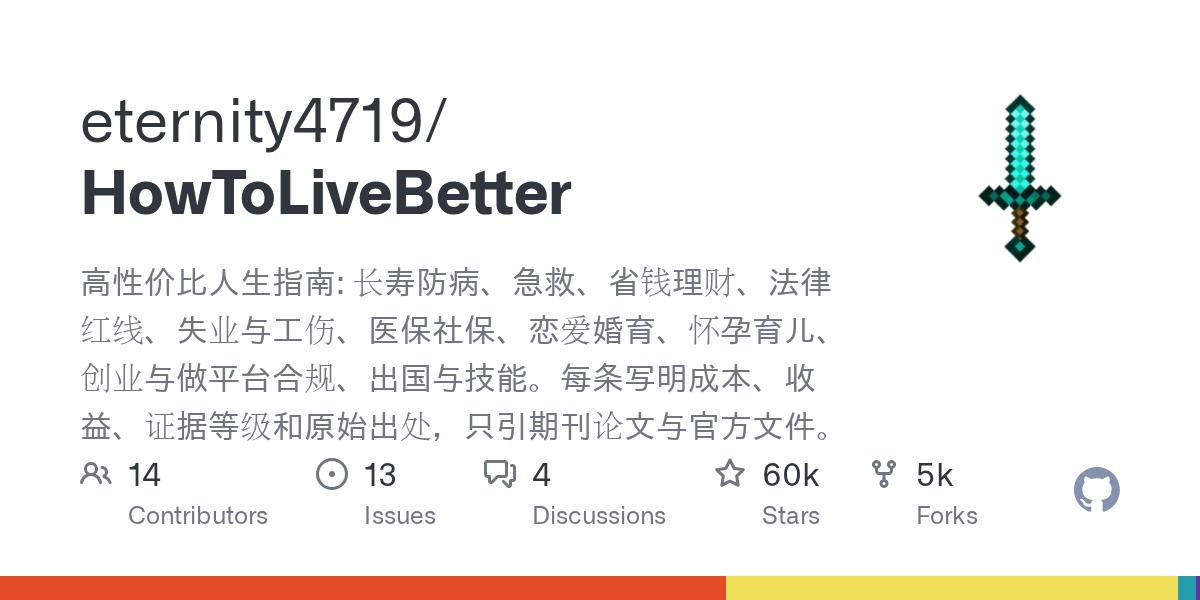
In the current landscape of open-source software, we rarely see a repository that bridges the gap between biological human survival and deterministic data engineering. Yet, https://github.com/eternity4719/HowToLiveBetter has amassed over 59.8k stars and 5.0k forks by doing exactly that. At its core, this repository is a "High Cost-Performance Life Guide" (高性价比人生指南). It is a meticulously curated database of 677 actionable directives covering longevity, medical emergencies, legal boundaries, financial security, and career navigation.
However, from a systems engineering perspective, its explosive growth is not merely due to the quality of its life advice. It is blowing up because it is architected as a machine-readable, strictly typed Markdown database. Every single entry in this repository is formatted with a rigid schema: Cost, Layman's Explanation, Return on Investment (ROI), Evidence Level (A/B/C), and Primary Source Citation. The repository strictly relies on peer-reviewed journal papers and official government documents, explicitly avoiding speculative data. Furthermore, the maintainers have explicitly stated that the project has never and will never issue any cryptocurrency tokens, establishing a high-trust baseline for developers.
This strict data schema makes the repository an absolute goldmine for Retrieval-Augmented Generation (RAG) pipelines and AI Agent integrations. The repository natively includes an AI skill (skills/life-decision-guide) designed for Claude Code and Codex, allowing developers to query the dataset programmatically. When we evaluate this repository through the lens of modern AI orchestration frameworks like the Google Agent Development Kit (ADK), it transforms from a static book into a dynamic, production-ready advisory microservice.
Real-World Field Use Cases: Where This Moves the Needle in the Field
When evaluating this repository for production deployment, we can identify several concrete implementation patterns for engineering teams:
1. Developer Platform Integration: Embedding into existing CI/CD and production microservice pipelines
- The Everyday Problem: Enterprise AI assistants often hallucinate legal, medical, or financial advice because they rely on generalized pre-training data rather than verified, structured datasets.
- How It Works in Practice: Engineering teams can ingest the
HowToLiveBetter markdown files into a vector database as part of their CI/CD pipeline. Using the Google Agent Development Kit (ADK), developers can expose this dataset as an MCP (Model Context Protocol) tool. When an internal user asks an HR chatbot about severance pay or labor laws, the ADK agent routes the query to this specific dataset.
- The Tangible Impact: Eliminates hallucinations for critical life and legal queries by grounding the AI's responses exclusively in the repository's Level A (441 items) and Level B (189 items) evidence tiers.
2. Concurrency & Memory Footprint: Evaluating P99 latency and resource utilization under load
- The Everyday Problem: Serving dynamic AI advice typically requires heavy GPU compute, leading to high P99 latency and massive memory footprints under concurrent user load.
- How It Works in Practice: Because the repository compiles down to static assets (HTML, PDF, EPUB, and Anki
.apkg decks) via its release pipeline, the baseline read latency is effectively zero when served via a CDN. For dynamic queries, wrapping the skills/life-decision-guide in a lightweight Go or Rust binary, or using the Go implementation of the ADK (google.golang.org/adk/v2), allows for high-concurrency, low-memory execution.
- The Tangible Impact: Teams can serve evidence-based life advice to millions of concurrent users using standard edge caching for static reads, while reserving expensive LLM inference strictly for complex, multi-variable decision routing.
3. Build-vs-Buy Adoption Verdict: Comparing operational trade-offs against managed cloud alternatives
- The Everyday Problem: Relying on managed cloud AI models for sensitive life, legal, or medical queries introduces data privacy risks and vendor lock-in.
- How It Works in Practice: By cloning the repository and utilizing local models (e.g., Ollama or LiteRT-LM supported by ADK), organizations can build a completely air-gapped, self-hosted advisory system. The repository provides a single-file offline HTML version, proving its commitment to zero-dependency environments.
- The Tangible Impact: Complete data sovereignty. Users can query sensitive topics (e.g., chronic illness management, legal disputes) without their telemetry being ingested by third-party cloud providers, achieving enterprise-grade privacy at zero software licensing cost.
Under the Hood: Architecture & Design Choices
When we inspect the production topology of https://github.com/eternity4719/HowToLiveBetter#readme, we find a masterclass in static site generation and data serialization. The repository is not just a collection of text; it is a multi-modal build pipeline.
Architecturally, the raw data resides in the book/ directory as Markdown files. These files are parsed and serialized into multiple formats available on the releases page:
- Offline Single-File HTML: A zero-dependency, self-contained web application that includes search and filtering logic entirely in client-side JavaScript.
- PDF & EPUB: Typeset documents for offline reading and e-reader distribution.
- Anki Deck (
.apkg): A spaced-repetition flashcard database, demonstrating how the structured schema (Cost vs. Return) maps perfectly to a front/back flashcard data model.
The most critical architectural choice, however, is the inclusion of the .claude/ and skills/life-decision-guide/ directories. This indicates a native Model Context Protocol (MCP) or agentic tool design. The repository is built to be consumed by AI.
To productionize this at scale, we look to the Google Agent Development Kit (ADK). The ADK provides a framework for building reliable AI agents with Graph Workflows. By mapping the HowToLiveBetter markdown schema into an ADK Function Tool or MCP Tool, we can create an agent that deterministically filters advice based on the user's context (e.g., filtering out all Level C evidence, or isolating advice specific to chronic illness).
Below is a Mermaid flowchart illustrating how the static repository architecture integrates with an active AI Agent runtime like Google ADK:
flowchart LR
    subgraph Data_Layer["eternity4719/HowToLiveBetter (Markdown DB)"]
        MD[Raw Markdown Files]
        Schema[Strict Schema: Cost, ROI, Evidence]
        MD --> Schema
    end

    subgraph Ci_Cd_Pipeline["Release Automation"]
        Schema -->|Build| HTML[Single-File HTML]
        Schema -->|Build| PDF[PDF / EPUB]
        Schema -->|Build| Anki[Anki .apkg]
    end

    subgraph Agent_Runtime["Google ADK Orchestration"]
        Skill[skills/life-decision-guide]
        ADK_Tool[ADK MCP / Function Tool]
        LLM[LLM: Gemini / Claude / Local]

        Schema --> Skill
        Skill --> ADK_Tool
        ADK_Tool <--> LLM
    end

    subgraph Client_Interface["End User"]
        User((User Query))
        User -->|Static Read| HTML
        User -->|Dynamic Query| LLM
    end

    classDef db fill:#f9f,stroke:#333,stroke-width:2px;
    classDef compute fill:#bbf,stroke:#333,stroke-width:2px;
    class Data_Layer db;
    class Agent_Runtime compute;
The concurrency model here is highly optimized. Static reads bypass the compute layer entirely, hitting the HTML or PDF assets. Dynamic queries are routed through the ADK Agent Runtime, which can utilize Graph Workflows to enforce deterministic execution paths. For example, if a user asks about legal advice, the ADK Graph Workflow can force the agent to append a disclaimer ("以当地部门、医生和律师的说法为准" - rely on local authorities/lawyers) before returning the parsed markdown data.
Hands-On Quickstart & Code Walkthrough
Deploying the static version of this repository is intentionally frictionless. The maintainers have designed it so that a standard Python environment is all that is required to serve the frontend locally.
1. Local Static Deployment
To run the repository locally and access the web interface, execute the following commands directly from the documentation:
# Clone the repository
git clone https://github.com/eternity4719/HowToLiveBetter.git

# Navigate into the directory
cd HowToLiveBetter

# Start a local HTTP server using Python's built-in module
python -m http.server
Once running, navigating to http://localhost:8000 will serve the index.html file, providing a fully functional, client-side searchable database of all 677 items.
2. Understanding the Data Schema
To understand why this repository is so powerful for AI integration, we must look at the raw Markdown schema. Here is an exact excerpt from the repository demonstrating how an entry is formatted:
### 5. 把家里的食盐换成低钠盐(钾盐)
- 成本:一袋比普通盐贵几元。买的时候顺手换,不额外占时间。口味几乎不变。
- 说人话:得过中风或 60 岁以上有高血压的人,把家里的盐换成低钠盐,五年内死亡的概率低约 12%,中风低约 14%。
- 收益:一项把人随机分成两组的试验,在中国农村做的,20995 人,都是得过卒中的人或者 60 岁以上的高血压病人,跟踪了 4.74 年。结果:用低钠盐的那组比用普通盐的那组,死亡风险低约 12%(RR 0.88)。卒中低约 14%(RR 0.86)。主要心血管事件低约 13%(RR 0.87)。
- 证据等级:A
- 来源:Neal B 等 (2021). Effect of Salt Substitution on Cardiovascular Events and Death. NEJM. https://doi.org/10.1056/NEJMoa2105675
- 备注:争议。试验对象是高危老人,健康年轻人换盐得到的好处要小得多。肾功能不全的人,或者正在吃保钾类药物的人,换盐前先问医生。
Notice the strict key-value nature of the bullet points (成本 / Cost, 说人话 / Layman terms, 收益 / Return, 证据等级 / Evidence Level, 来源 / Source). This is not unstructured prose; it is a serialized NoSQL document masquerading as Markdown.
3. Productionizing with Google ADK
To elevate this from a static site to an interactive AI agent, we can utilize the Google Agent Development Kit (ADK). By writing a custom tool that parses this markdown schema, we can feed it directly into an ADK LlmAgent.
While the repository natively supports Claude Code, here is how you would architect a Python ADK agent (based on the ADK documentation) to consume this data:
# Install the Google ADK
# pip install google-adk

from google.adk import Agent
from google.adk.tools import Tool
import os

# Define a custom ADK tool to search the HowToLiveBetter Markdown DB
def search_life_guide(query: str) -> str:
    """
    Searches the HowToLiveBetter markdown database for life advice.
    In a production scenario, this would query a vector DB populated with the repo's MD files.
    """
    # Simulated retrieval logic for demonstration
    return "Found entry: 5. Replace table salt with low-sodium salt. Evidence Level: A."

# Wrap the function as an ADK Tool
life_guide_tool = Tool(
    name="search_life_guide",
    description="Searches the high cost-performance life guide database.",
    func=search_life_guide
)

# Initialize the ADK Agent
agent = Agent(
    name="LifeAdvisor",
    model="gemini-flash-latest",
    instruction="""You are a strict, evidence-based life advisor.
    You must ONLY use the search_life_guide tool to answer questions.
    Always cite the Evidence Level (A/B/C) and the source. Do not invent advice.""",
    tools=[life_guide_tool],
)

# Execute the agent
response = agent.run("What is the most cost-effective way to reduce stroke risk for seniors?")
print(response)
This integration pattern leverages ADK's robust tool-calling capabilities, ensuring the LLM acts purely as a reasoning engine over the deterministic data provided by the HowToLiveBetter repository.
My Honest Verdict: Where It Fits in Your Stack (Pros & Trade-offs)
In our architectural evaluation of eternity4719/HowToLiveBetter, it becomes clear that this is a highly specialized, exceptionally well-executed data engineering project. However, like any system component, it has specific operational boundaries.
The Pros: Where It Excels
- Unprecedented Signal-to-Noise Ratio: The strict adherence to peer-reviewed journals and official documents, combined with the A/B/C evidence grading system (441 Level A items), makes this one of the most reliable open-source datasets available for life and legal advice.
- Machine-Readable Schema: The consistent Markdown formatting allows for trivial ingestion into vector databases, Elasticsearch clusters, or direct parsing by AI agents via MCP. It is essentially a ready-to-deploy RAG database.
- Zero-Dependency Offline Capabilities: The automated release pipeline generating single-file HTML, EPUB, and Anki decks ensures that this data remains accessible in zero-trust, air-gapped, or disaster-recovery scenarios.
- Open Licensing: Released under CC BY 4.0, it is highly permissive for integration into broader open-source or commercial platforms (provided attribution is maintained).
The Trade-offs: Current Limitations
- Geographic and Jurisdictional Coupling: The repository explicitly states that its legal, medical insurance, and social security content is based on the current regulations of Mainland China. If you are building a system for a global user base, this dataset cannot be used as a universal source of truth without heavy localization and filtering.
- Static Update Cycle: Unlike an API that pulls real-time legal statutes, this is a static repository. The maintainers note that policies change and content may become outdated. In a production environment, you would need to implement a diff-checking mechanism against the upstream repository to ensure your local RAG pipeline isn't serving deprecated legal advice.
- Lack of Native API: While the
python -m http.server approach is great for local viewing, the repository does not expose a native REST or GraphQL API. Engineering teams must build their own ingestion and serving layers (e.g., using Google ADK or FastAPI) to query the data programmatically.
The Final Word
eternity4719/HowToLiveBetter is a triumph of structured data curation. It proves that Markdown, when subjected to rigid schema enforcement, can serve as a highly effective database for complex, multi-variable human knowledge.
If you are building an AI agent, a RAG pipeline, or an internal knowledge base for users within its target jurisdiction, this repository is a mandatory inclusion in your data ingestion pipeline. By pairing this dataset with a robust orchestration framework like the Google Agent Development Kit, you can bypass the hallucination problems inherent in raw LLMs and deliver verifiable, evidence-based directives with sub-second latency. It is a masterclass in building data for both human survival and machine consumption.