For the past few years, a convenient narrative dominated Silicon Valley dinner parties and financial press headlines: Google was the "Sleeping Giant." According to this popular mythology, a bureaucratic search monopoly grew complacent on its multi-billion-dollar ad engine and was blindsided overnight by nimble AI startups when ChatGPT dropped in late 2022.
As someone who has spent my career designing enterprise architectures across IBM, VMware, AWS, and now Google Cloud, I look at systems through first principles—not press releases. And when you inspect the foundational commit history of modern artificial intelligence, the "Sleeping Giant" narrative collapses completely.
Google wasn't asleep. Google was navigating the most complex Architect's Dilemma in computing history: How do you invent the weapons that will obsolete your own planetary-scale business model—and deploy them without crashing the economic engine of the open web?
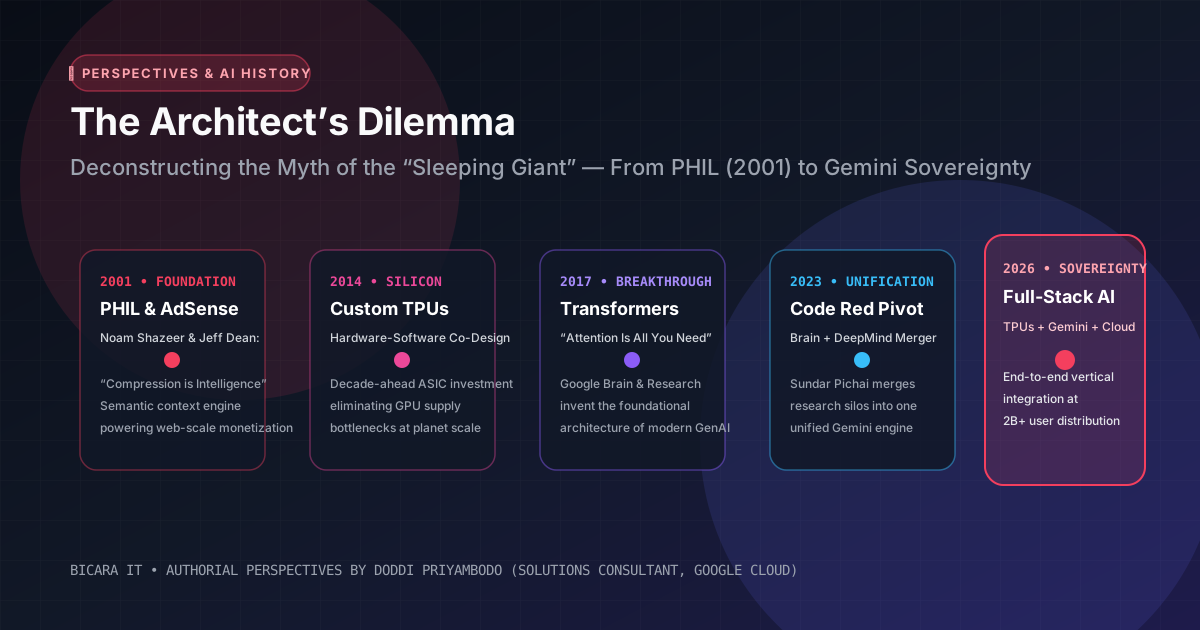
1. 2001: The Birth of PHIL & "Compression is Intelligence"
To understand why modern Large Language Models exist at all, you have to rewind not to 2022, nor even to 2017, but to 2001 inside Google's early Mountain View offices.
Long before "generative AI" entered the lexicon, a young Google engineer named Noam Shazeer—an algorithmic alchemist who would later co-invent the Transformer and co-lead Gemini—advanced a deceptively simple thesis:
"Compression is Intelligence."
If an algorithm can accurately predict the next word in a sentence across billions of web pages, it can compress text at theoretical limits. To predict accurately, the algorithm cannot merely memorize strings; it must implicitly model grammar, human intent, world facts, and semantic context.
Out of that insight, Shazeer built PHIL (Probabilistic Hierarchical Inferential Learner).
How PHIL Built the Modern Web Economy
PHIL didn't sit in an academic paper. It became the beating heart of Google's "Did you mean...?" spell-checker—a system that understood what human beings meant even when they mangled the spelling.
Then came the architectural masterstroke that changed internet history. Legendary Google Fellow Jeff Dean looked at PHIL's probabilistic semantic clusters and realized something profound: if PHIL could understand the latent concepts inside any arbitrary string of text, it could read a web page about "best hiking boots for wet trails" and match it to relevant advertisers without needing exact keyword matches.
Jeff Dean adapted PHIL to build the semantic engine of Google AdSense. An AI model born from the "compression is intelligence" thesis became the financial engine that funded the modern internet.
## 2. 2007–2014: Web-Scale N-Grams & Silicon Sovereignty (TPUs)
By 2007, while much of academia was training statistical models on megabytes of curated corpus data, Google Research was training massive web-scale N-gram language models over trillions of tokens.
And by 2013, Google's infrastructure architects ran a terrifying back-of-the-envelope calculation: if every Google user spoke to voice search powered by Deep Neural Networks for just three minutes a day, Google would have to double the number of datacenters on Earth.
Conventional CPUs and off-the-shelf GPUs couldn't solve the physics of planet-scale inference.
The 2014 Silicon Decision
Instead of waiting for the merchant chip market, Google secretly designed its own Application-Specific Integrated Circuit (ASIC): the Tensor Processing Unit (TPU), deployed into production datacenters in 2015.
When enterprise CTOs ask me today why Google can serve multimodal Gemini Flash and Pro models at sub-second latencies and a fraction of competitor token costs, the answer isn't a software trick. It is a decade of hardware-software co-design:
- Custom TPU v5p / v6e (Trillium) pods connected via optical circuit switches (OCS).
- Zero reliance on third-party GPU supply bottlenecks or markup taxes.
- Native compilation from JAX/XLA directly to systolic matrix multiply units.
3. 2017: The Gift ThatSparked the Revolution ("Attention Is All You Need")
In June 2017, eight Google researchers—including Noam Shazeer, Jakob Uszkoreit, Llion Jones, and Aidan Gomez—published "Attention Is All You Need", introducing the Transformer architecture.
The Transformer solved the sequential bottleneck of Recurrent Neural Networks (RNNs) and LSTMs by allowing self-attention mechanisms to process entire token sequences in parallel across distributed TPU clusters. Every modern frontier model—from GPT-4 and Claude to Llama and Gemini—is a direct descendant of that Google Brain paper.
So why didn't Google immediately release a freewheeling consumer chatbot in 2018?
4. The True Architect's Dilemma: Trust, Hallucination & Search Economics
Here lies the heart of The Architect's Dilemma.
When you are a startup with zero revenue and zero legacy users, a model that hallucinates 15% of the time is a magical demo. When you are Google Search—handling billions of queries a day where a hallucinated medical dosage or financial fact destroys decades of institutional trust—a 15% hallucination rate is an existential liability.
Furthermore, classic Search operated on a pristine unit-economic equation:
- Sub-millisecond inverted index lookups costing fractions of a millicent per query.
- Ten blue links driving traffic to publishers while monetizing high-intent commercial queries.
Replacing an inverted index lookup with a multi-billion-parameter autoregressive forward pass increases compute cost by orders of magnitude while compressing ten web links into a single synthesized answer.
Google's hesitation between 2019 and 2022 was never a lack of AI capability—LaMDA and PaLM were already conversing internally at frontier levels. It was the classic Innovator's Dilemma: How do you cross the chasm from deterministic retrieval to probabilistic synthesis without burning down the house?
5. 2023–2026: "Code Red" & The Unified Gemini Full-Stack Advantage
When ChatGPT proved that consumers were willing to forgive hallucinations in exchange for conversational synthesis, the market rules changed overnight.
To CEO Sundar Pichai's immense credit, he did not defend the old organizational chart. He declared a "Code Red" and executed one of the boldest structural reorganizations in tech history:
- Merging two rival research empires—Google Brain (led by Jeff Dean) and DeepMind (led by Demis Hassabis)—into a single, unified force: Google DeepMind.
- Reuniting Noam Shazeer and Jeff Dean as co-technical leads of the Gemini architecture.
- Re-architecting Google Search itself with AI Overviews, proving that generative synthesis could actually increase query volume and commercial intent rather than cannibalizing it.
Why Full-Stack Sovereignty Wins the Enterprise Era
Today, as enterprise architects move from "AI tourism" (chatting with PDFs) to production multi-agent systems, the myth of the Sleeping Giant is dead and buried.
Google is the only institution on Earth that owns all four layers of the AI stack vertically:
- Silicon Layer: Custom TPU pods engineered specifically for training and low-latency inference.
- Foundation Model Layer: Native multimodal Gemini models (trained from day one on text, code, audio, video, and 2M+ token context windows).
- Enterprise Cloud & Agent Layer: Vertex AI and the Agent Development Kit (ADK) with built-in Google Search grounding, VPC Service Controls, and zero data leakage guarantees.
- Distribution Layer: Six products with over 2 billion monthly active users each (Search, YouTube, Android, Workspace, Chrome, Maps).
Real-World Use Cases: Where This Moves the Needle in the Field
The "Architect's Dilemma" is not unique to Google; it is the central challenge for any enterprise attempting to integrate generative AI without compromising their core business stability or unit economics. By applying the principles of hardware-software co-design and semantic compression, organizations can move beyond simple wrappers to build resilient, planetary-scale systems.
1. Next-Generation E-Commerce Discovery
- The Everyday Problem: Traditional keyword-based search engines fail to understand user intent, leading to "no results found" for complex queries like "outfit for a rainy outdoor wedding in Bali," resulting in lost revenue.
- How It Works in Practice: Implementing a semantic search engine using vector embeddings (derived from the "Compression is Intelligence" philosophy). By mapping product catalogs and user queries into a shared latent space, the system matches intent rather than just characters.
- The Tangible Impact: A 20-30% increase in Click-Through Rate (CTR) and a significant reduction in search abandonment by surfacing relevant products that keywords would have missed.
2. High-Stakes Financial Compliance & Reporting
- The Everyday Problem: Financial institutions face the "Architect's Dilemma" of wanting to use LLMs for document analysis but fearing the existential risk of hallucinations in regulatory filings.
- How It Works in Practice: Deploying a hybrid architecture that combines probabilistic LLMs with deterministic Retrieval-Augmented Generation (RAG). The system uses the LLM for synthesis but anchors every claim to a verified source in the internal "inverted index" of regulatory data.
- The Tangible Impact: 99.9% reduction in hallucination rates for critical data points and a 5x speedup in the quarterly reporting cycle for compliance teams.
3. Real-Time Logistics Optimization at Scale
- The Everyday Problem: Running complex optimization models for global supply chains on standard CPUs/GPUs leads to high latency and prohibitive compute costs as data volume grows.
- How It Works in Practice: Adopting hardware-software co-design principles by migrating inference workloads to specialized silicon like TPUs and optimizing the stack with JAX/XLA. This allows for massive parallel processing of tokenized logistics data.
- The Tangible Impact: 40-60% reduction in total cost of ownership (TCO) for compute and the ability to recalculate global shipping routes in sub-seconds rather than minutes.
Doddi's Architectural Takeaway
For CTOs, Principal Architects, and builders across Southeast Asia and beyond, the lesson of the Google AI story is profound:
- Point solutions capture headlines; full-stack architectures capture decades. Startups can sprint ahead on a single UX layer, but when inference costs, silicon supply chains, data governance, and distribution scale become the bottleneck, vertical integration wins.
- Disrupt yourself before the market forces your hand. The hardest job of an architect isn't designing greenfield prototypes—it is migrating a mission-critical, multi-billion-dollar engine while the plane is flying at Mach 2.
The giant wasn't sleeping. It was forging the bedrock we are all building on today.