Here is a financial horror story common to almost every enterprise adopting AI: the idle GPU graveyard.
To run a specialized vector embedding pipeline, an image segmentation service, or an open-source reranker, engineering teams traditionally deploy dedicated node pools on Google Kubernetes Engine (GKE) or Compute Engine. They provision an NVIDIA L4 or A100 GPU instance to ensure sub-second response times.
Then traffic dies down at 7:00 PM. Throughout the night and weekend, those GPU nodes sit at 1% utilization, quietly burning hundreds of dollars in company budget while waiting for a single HTTP request.
Leasing dedicated GPU clusters for bursty microservices is like leasing a $15,000/month luxury penthouse year-round just to sleep there two hours on Saturday night. What engineering teams actually need is a boutique hotel room that charges by the minute when the keycard is in the door, and bills exactly $0.00 when the room is empty.
With the general availability of Native GPU Support on Google Cloud Run, serverless container economics have finally arrived for accelerated computing.
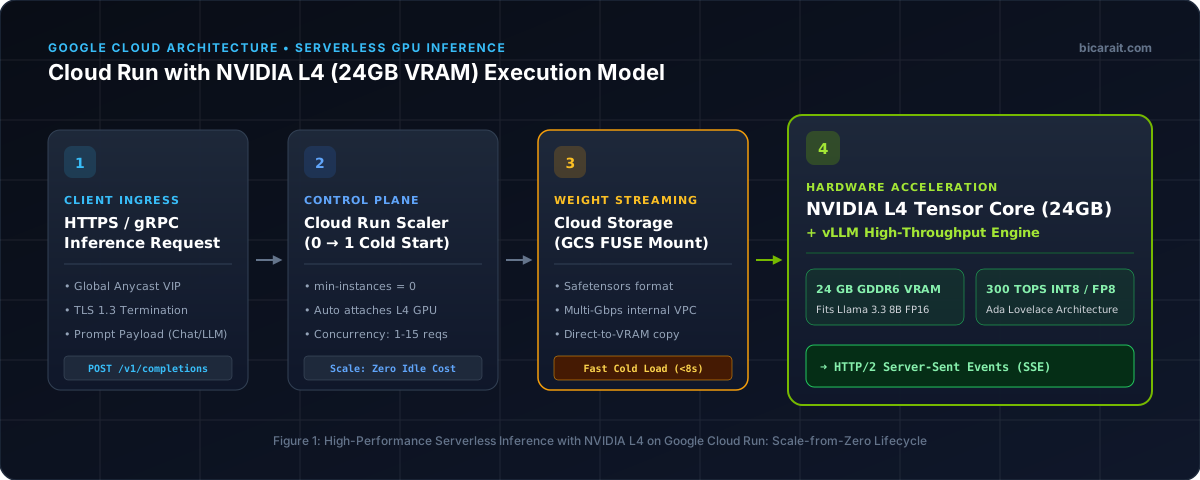 Figure 1: Scale-from-Zero Architecture and Weights Streaming Lifecycle with NVIDIA L4 GPUs on Cloud Run.
💡 Executive Blueprint (TL;DR)
💡 Executive Blueprint (TL;DR)
Google Cloud Run with Native GPU Support enables teams to deploy containerized AI workloads on NVIDIA L4 GPUs with automatic scale-to-zero capabilities. By billing strictly per-millisecond while requests are processing and streaming container layers from Artifact Registry, Cloud Run eliminates idle GPU expenses without requiring Kubernetes cluster operations.
┌─────────────────────────────────────────────────────────────────────────────┐
│                 DEDICATED GKE vs. SERVERLESS CLOUD RUN GPU                  │
├─────────────────────────────────────────────────────────────────────────────┤
│ Dedicated GKE GPU Node Pool (Always On, High Base Cost):                    │
│ [Mon-Fri: High Load] [Sat-Sun: Zero Load (Still Billed $450/month per GPU)] │
├─────────────────────────────────────────────────────────────────────────────┤
│ Google Cloud Run Native GPU (Scale-to-Zero, True Utility Billing):          │
│ [Active Requests ➔ 1 Instance Billed] ➔ [No Traffic ➔ 0 Instances Billed $0]│
│ 💰 Result: Up to 70% Infrastructure Cost Reduction for Bursty AI Services   │
└─────────────────────────────────────────────────────────────────────────────┘
📊 Serving Architecture Comparison Matrix
| Architectural Factor |
Dedicated GKE GPU Cluster |
Compute Engine VM Pool |
Cloud Run Native GPU |
| Idle Billing Penalty |
High: Billed 24/7 regardless of load |
High: Billed continuously |
Zero: Billed strictly per millisecond of request |
| Cluster Maintenance |
Node OS upgrades & K8s patches |
OS image patching & systemd |
Zero: 100% managed serverless environment |
| Cold Start Mitigation |
Instant (nodes pre-warmed) |
Slow (VM boot overhead) |
Optimized: Streaming Artifact Registry images |
| Hardware Target |
Full Nvidia Catalog (H100, A100, L4) |
Full Nvidia Catalog |
NVIDIA L4 (24GB VRAM) |
| Autoscaling Mechanics |
Cluster Autoscaler (2–5 min delay) |
Instance Groups (3–6 min) |
Rapid Concurrency Scaling (Seconds) |
🔬 Architectural Blueprint 1: How Scale-to-Zero Works with Massive Weights
The historic technical hurdle preventing serverless GPU containers was image size.
A container image bundling PyTorch, CUDA runtime drivers, and a 7-billion-parameter model checkpoint easily reaches 15GB to 25GB in size. Pulling a 20GB layer over the network on a cold start would introduce 45-second latency spikes, defeating the purpose of serverless.
Google Cloud Run overcomes this through two deep infrastructure integrations:
- Regional Container Streaming: Cloud Run integrates with Artifact Registry to stream image blocks on-demand. The container begins initializing CUDA kernels before the entire 20GB image finishes downloading.
- Persistent Fast Disk Caching: By mounting Cloud Storage FUSE or regional hyperdisks, model weights can be memory-mapped into GPU VRAM in seconds.
🔬 Architectural Blueprint 2: Production Service Specification
Deploying an optimized HuggingFace embedding microservice on an NVIDIA L4 GPU requires zero Kubernetes manifests—just a clean, declarative Knative service definition:
apiVersion: serving.knative.dev/v1
kind: Service
metadata:
  name: semantic-embed-service
  annotations:
    run.googleapis.com/ingress: internal-and-cloud-load-balancing
spec:
  template:
    metadata:
      annotations:
        # Request dedicated NVIDIA L4 GPU acceleration
        run.googleapis.com/gpu-type: nvidia-l4
        run.googleapis.com/gpu-count: "1"
        # Enforce scale-to-zero when idle for 60 seconds
        autoscaling.knative.dev/minScale: "0"
        autoscaling.knative.dev/maxScale: "10"
    spec:
      containerConcurrency: 4 # Concurrent requests per GPU instance
      containers:
        - image: us-central1-docker.pkg.dev/my-retail-prod/ai-repo/bge-reranker:latest
          resources:
            limits:
              cpu: "4"
              memory: "16Gi"
          env:
            - name: MODEL_NAME
              value: "BAAI/bge-reranker-large"
            - name: TORCH_DEVICE
              value: "cuda"
🎯 The Editorial Verdict
If your application serves continuous, 24/7 high-volume inference exceeding 1,000 queries per second, a tightly packed GKE cluster with vLLM remains the most cost-efficient architectural choice.
However, for the long tail of enterprise AI workloads—batch document ingestion, overnight report summarization, voice transcription on demand, or internal employee AI tools—Cloud Run GPU is an absolute game-changer.
It eliminates idle billing overnight and frees senior engineering bandwidth from managing Kubernetes node pools.
Real-World Use Cases: Where This Moves the Needle in the Field
At DO-AI, we observe that the primary barrier to AI adoption isn't the model logic, but the prohibitive cost of keeping specialized hardware warm. Native GPU support on Cloud Run changes the unit economics of AI, allowing teams to deploy high-performance models as easily as a simple web API. Here are three ways to implement this today:
1. On-Demand Legal & Compliance Document Intelligence
- The Everyday Problem: Legal teams often need to process 5,000 contracts for a specific audit once a month. Maintaining a dedicated GPU cluster for these sporadic bursts results in 29 days of wasted infrastructure spend.
- How It Works in Practice: Deploy a document-parsing microservice (e.g., LayoutLM or a quantized Llama-3) on Cloud Run with an NVIDIA L4. The service stays at zero instances until the audit begins, then scales to 10+ concurrent GPUs to process the batch, and shuts down immediately after.
- The Tangible Impact: Reduces monthly infrastructure overhead by up to 85% compared to a fixed-size GKE node pool while maintaining sub-second inference speeds.
2. E-commerce Visual Search & Recommendations
- The Everyday Problem: Retailers want to offer "Search by Image," but traffic is highly volatile—peaking during lunch hours and dropping to near-zero at 3:00 AM. CPU-based embedding is too slow, and dedicated GPUs are too expensive for off-peak hours.
- How It Works in Practice: Use a CLIP (Contrastive Language-Image Pre-training) model containerized on Cloud Run GPU. When a user uploads a photo, Cloud Run spins up an L4 instance to generate the vector embedding in milliseconds.
- The Tangible Impact: Provides a premium, low-latency user experience without the "idle tax" of running GPUs during low-traffic periods.
3. Automated Media Transcription & Translation
- The Everyday Problem: Content platforms need to generate subtitles for user-uploaded videos. Using CPU-only serverless functions leads to timeouts for long videos, while dedicated GPU VMs require complex job queue management.
- How It Works in Practice: Implement OpenAI’s Whisper model on Cloud Run GPU. The system triggers a container execution whenever a new file hits Cloud Storage. The GPU acceleration ensures even 30-minute videos are transcribed in a fraction of the time.
- The Tangible Impact: Faster time-to-publish for creators and simplified architecture by removing the need for complex Kubernetes pod autoscaling logic.